If you are still managing orders through phone calls, handwritten notes, or multiple disconnected tools, you are likely losing time, accuracy, and revenue every day.
As order volumes increase and customer expectations shift toward faster service, manual processes begin to break down.
-
Orders get missed,
-
Preparation slows down, and
-
Delivery coordination becomes harder to manage
Customers today expect a simple and reliable way to order food. They want to browse menus, place orders, and track deliveries without friction.
For you, this means your system must handle more than just order intake. It must support your entire operation, from order capture to final delivery.
This is where an online ordering system for restaurants becomes essential.
It is not just a digital tool for convenience. It is a structured system that connects ordering, kitchen operations, payments, and delivery into one workflow, which helps you run your restaurant more efficiently.
In this article, you will understand what an online ordering system is!
Let’s begin.
What Is an Online Ordering System for Restaurants?
An online ordering system for restaurants is a digital platform that allows customers to place food orders through a website, mobile app, or kiosk, while enabling restaurants to manage orders, payments, kitchen operations, and delivery from a centralized system.
What Does an Online Ordering System Actually Do?
To understand its real value, you need to look at what the system handles daily. Here’s what an online ordering system for restaurants do:
-
Accepts orders from multiple digital channels
-
Processes payments securely and instantly
-
Organizes incoming orders in a structured workflow
-
Connects customer orders with kitchen operations
-
Coordinates delivery or pickup without manual intervention
Instead of relying on calls or scattered tools, everything is managed through one system. This reduces confusion and ensures that every order is handled consistently.
How an Online Ordering System Works (Step-by-Step)
Understanding how the online ordering system works helps you see how your operations become more structured and efficient.
Here is how a typical order moves through the system:
-
A customer selects items and places an order online
-
The order is instantly recorded in the system dashboard
-
The kitchen receives the order for preparation
-
A delivery driver is assigned if required
-
The order is tracked until it is completed
This process happens in real time without the need for manual coordination.
Here’s a quick ordering flow with action and system role:
| Step | Action | System Role |
|---|---|---|
| Order Placement | Customer selects items | Captures order |
| Processing | Sent to restaurant | Organizes workflow |
| Preparation | Kitchen prepares | Syncs operations |
| Dispatch | Driver assigned | Manages delivery |
| Completion | Delivered | Updates system |
This structured workflow ensures that every order follows the same process, thereby reducing errors and delays.
Expert Tip:
If your team still relies on verbal communication between staff and kitchen, errors are unavoidable. A structured system removes this dependency and improves consistency.
Key Components of a Restaurant Online Ordering System
To understand the real value of an online ordering system for restaurants, you need to look at it as a connected workflow, not separate tools.
Let’s break this down in a way that reflects how your restaurant actually operates.
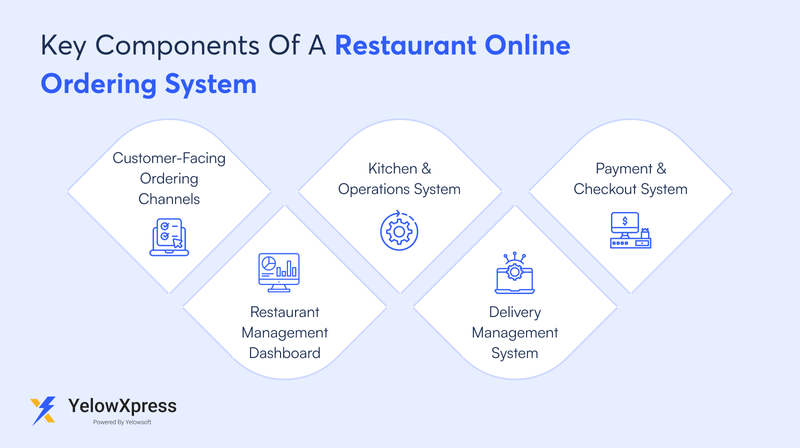
Customer-Facing Ordering Channels
This is where every order begins.
Your customers need a simple and reliable way to place orders without calling or waiting. These channels act as your digital storefront:
-
Website ordering
-
Mobile applications
-
QR-based ordering
When these channels are properly set up, customers can browse your menu, select items, and place orders on their own.
This reduces dependency on staff and ensures that orders are captured accurately.
👉 Think of this as the entry point of your entire system.
Restaurant Management Dashboard
Once an order is placed, it needs to be organized and tracked.
The restaurant management dashboard acts as your central control system where you can:
-
View incoming orders in real time
-
Update order status
-
Manage menu and pricing
-
Monitor performance
Instead of handling orders across calls, paper, or different tools, everything is visible in one place.
👉 This is where you gain control over your operations.
Kitchen & Operations System
After the order is received, it must reach the kitchen clearly and without delay.
This is handled through:
-
Kitchen display system
-
Order prioritization
Orders are displayed directly to the kitchen in a structured format. This removes the need for verbal communication or manual notes, which often lead to mistakes.
👉 This component ensures that what is ordered is prepared correctly and on time.
Delivery Management System
Once the food is ready, the next challenge is getting it to the customer efficiently.
This system manages:
-
Driver assignment
-
Route planning
Instead of manually calling drivers or coordinating delivery, the system handles dispatch and tracking automatically.
👉 This is where your operation shifts from preparation to execution.
Payment & Checkout System
Every order must be completed with a secure and reliable transaction.
This includes:
-
Online payment processing
-
Cash on delivery handling
-
Secure checkout
Payments are recorded automatically, reducing errors and simplifying accounting.
👉 This ensures that every transaction is tracked and managed properly.
Expert Tip:
Many restaurants try to solve problems by adding separate tools for ordering, delivery, and management. This creates more complexity. A unified system works better because it connects every step into a single workflow.
Benefits of Using an Online Ordering System for Restaurants
Once your ordering, kitchen, and delivery processes are connected into a single system, the impact becomes visible across your entire operation.
Let’s look at these benefits step by step.
Increased Order Volume
When customers find it easy to place orders, they are more likely to complete them.
An online ordering system for restaurants removes common barriers such as waiting on calls or limited ordering hours.
-
Customers can order anytime without dependency on staff
-
Faster ordering process leads to higher conversion
-
Multiple channels increase accessibility
As a result, you create more opportunities for orders without increasing operational effort.
Better Customer Experience
Once orders start coming in consistently, the next priority is how smoothly customers move through the process. A structured system improves the entire ordering journey.
-
Simple and intuitive ordering interface
-
Real-time updates on order status
-
Transparent delivery tracking
This clarity builds trust and encourages repeat orders over time.
Operational Efficiency
As order volume increases, manual handling becomes difficult to manage. This is where automation begins to improve daily operations.
-
Orders are processed automatically without manual entry
-
Reduced chances of communication errors
-
Faster coordination between front-end and kitchen
This allows your team to focus more on preparation and service instead of coordination.
Higher Profit Margins
With operations running smoothly, the next impact is on your revenue structure. One of the biggest advantages is reducing dependency on external platforms.
-
Direct orders reduce third-party commission costs
-
Better control over pricing and promotions
-
Increased revenue retention per order
This improves profitability without increasing costs.
Data and Insights for Growth
As your system continues to process orders, it also collects valuable data that can guide your decisions.
-
Identify popular menu items and peak hours
-
Understand customer ordering patterns
-
Track sales performance over time
These insights help you make informed decisions instead of relying on assumptions.
Online Ordering System vs Traditional Ordering Methods
Here’s a quick comparison that highlights why digital systems are becoming essential.
| Factor | Traditional Ordering | Online Ordering System |
|---|---|---|
| Order Handling | Manual | Automated |
| Errors | High | Minimal |
| Speed | Slow | Fast |
| Scalability | Limited | High |
| Customer Experience | Basic | Enhanced |
Manual systems depend heavily on human coordination. Whereas, digital systems rely on structured workflows that improve reliability.
Who Needs an Online Ordering System?
Different types of businesses benefit from the same system in different ways.
Independent Restaurants: Helps manage growing demand without increasing staff dependency.
Cloud Kitchens: Supports delivery-focused operations with better coordination.
Multi-Outlet Chains: Enables centralized control across multiple locations.
Food Delivery Startups: Provides the foundation to build scalable operations.
📌 While the scale may differ, the need for structured operations remains the same.
How to Choose the Right Online Ordering System for Your Restaurant
Choosing an online ordering system for restaurants is not about selecting the one with the most features. It is about finding a system that fits how your restaurant actually operates today and how you plan to grow in the future.
Before making a decision, you need to assess it from an operational standpoint.
Key Factors to Consider
Start by evaluating how the system performs in real working conditions, not just in a demo.
- Ease of Use
Your staff should be able to use the system without confusion. If it requires constant training or manual intervention, it will slow down operations.
- Customization Flexibility
Your menu, pricing, and workflows are unique. The system should allow you to adjust these without restrictions.
- Integration Capability
It should connect easily with your existing tools such as POS, payment gateways, and delivery systems.
- Delivery Management Support
If you handle deliveries, the system must support driver assignment, tracking, and coordination.
- Scalability
The system should handle increased order volume and support multiple outlets as your business grows.
👉 These factors ensure that the system works with your operations, not against them.
Conclusion
Restaurant operations are becoming more demanding as order volumes increase and customer expectations continue to evolve.
Managing orders manually or through disconnected tools limits your ability to maintain accuracy, speed, and consistency. Over time, this affects both customer experience and overall profitability.
So, an online ordering system for restaurants is no longer just a convenience. It is a structured way to manage orders, streamline operations, and maintain control over your business.
It helps you reduce errors, improve service speed, and handle higher demand without increasing operational complexity.
If you want to run a more efficient operation, you need a system that connects ordering, kitchen, and delivery into one workflow.
With YelowXpress’s online ordering and delivery software for restaurants, you can take direct orders, automate dispatch, track every order in real time, and manage your entire operation from a single dashboard.
This gives you full control over your revenue, customer experience, and daily operations.
So why wait? Implement YelowXpress today!
Take control of orders and delivery with YelowXpress’s restaurant ordering and delivery software today.
FAQs
An online ordering system for restaurants is a digital platform that lets customers place orders via website or app while helping you manage orders, payments, kitchen flow, and delivery from one centralized system.
It automates order processing, reduces manual errors, and connects ordering with kitchen and delivery. This improves speed, accuracy, and coordination, allowing your team to handle more orders efficiently.
Yes, even small restaurants benefit by reducing manual workload, improving order accuracy, and increasing order volume. It helps you operate efficiently without needing additional staff or complex processes.
It gives you more control over pricing, customer data, and profits. Unlike aggregators, you avoid high commissions and build direct relationships with customers, improving long-term business sustainability.