Not long ago, home delivery was something customers expected from large supermarket chains.
Today, things look different.
A neighborhood grocery store. A specialty food retailer. A local organic market. Customers expect all of them to offer online ordering and delivery.
The shift has happened quietly, but the numbers leave little room for doubt. The global online grocery market has already crossed $650 billion. In the United States, online grocery sales exceeded $127 billion in 2025. Research also suggests that the market will continue expanding as consumers become increasingly comfortable buying groceries online.
For grocery store owners, that growth creates a huge opportunity.
It also creates a difficult decision.
Should you rely on marketplaces to handle delivery, or should you build your own delivery operation?
Many businesses choose marketplaces because they seem like the easiest option. The platform brings traffic, manages the ordering experience, and helps retailers get started quickly.
But over time, the drawbacks become harder to ignore.
Commissions grow. Delivery fees increase. Promotional spending becomes necessary. Customer ownership disappears.
Eventually, many operators reach the same conclusion.
There has to be a better way.
The good news is that there is.
With the right grocery delivery software, grocery stores can launch home delivery, build direct customer relationships, and keep more of the revenue generated from every order.
Why More Grocery Stores Are Looking Beyond Marketplace Platforms
Marketplace platforms solved an important problem.
They helped grocery retailers enter digital commerce without making a major investment upfront.
For many businesses, that was exactly what they needed.
A quick setup. Access to customers. Immediate order volume.
Everything looked positive.
At first.
Convenience Can Be Expensive
Imagine a grocery store receiving 800 delivery orders every month through a marketplace.
Sales are growing. Customer demand looks healthy. Online ordering appears successful.
Then the owner reviews the numbers.
A percentage of every order disappears into commissions. More money is spent on promotions to stay visible.
Delivery related costs continue increasing. Order volume rises, but profits remain stagnant.
This is not unusual.
Many grocery operators discover that marketplaces are excellent at generating transactions, but not always great at protecting margins.
The more dependent a business becomes on a marketplace, the harder it becomes to control profitability.
Grocery Margins Leave Little Room for Extra Costs
Unlike luxury products or specialty retail categories, grocery businesses often operate with relatively small margins.
That means every percentage point matters.
When commissions, promotional fees, and delivery costs are added to every transaction, profitability can shrink surprisingly fast.
Consumer behavior is also shifting.
Research shows that 61% of consumers purchase groceries online.
Even more interesting, 52% prefer ordering directly through a retailer's website or mobile app, while only 27% primarily rely on third party aggregators.
That statistic highlights a major opportunity. Customers are already willing to buy directly from grocery stores.
The challenge is providing an experience that makes direct ordering easy.
Customer Ownership Is Becoming a Competitive Advantage
A marketplace helps facilitate the sale.
It rarely helps build your brand.
When customers order through your own channels, you gain something far more valuable than a single transaction.
You gain insight. You know what products customers buy. You know how often they order. You understand seasonal purchasing behavior.
You can create targeted offers based on actual customer preferences.
Over time, that information becomes one of the strongest assets a grocery business can own.
Expert Tip:
Many grocery businesses focus heavily on acquiring new customers. Yet increasing repeat purchase frequency often generates more profit than acquiring additional traffic through paid channels.
The Growing Opportunity in Online Grocery Delivery
Online grocery shopping is no longer considered an emerging trend.
It is becoming standard consumer behavior.
Grocery Ecommerce Continues to Expand
Industry reports estimate the online grocery delivery market at roughly $750 billion globally.
Forecasts suggest the market could grow at a 23.1% CAGR between 2024 and 2029, adding more than $1 trillion in value. Some projections estimate that online grocery sales could exceed $883 billion by 2035.
What do these numbers mean for grocery retailers? Simply put, customer demand is moving online. The businesses that adapt now will likely be in a stronger position later.
Consumers Are Becoming Comfortable With Direct Ordering
Many customers no longer see online grocery ordering as complicated.
They see it as normal.
Research shows that nearly 69% of shoppers purchase groceries online at least occasionally.
More importantly, over half prefer ordering directly from retailers.
That creates an opportunity for stores to reduce dependency on intermediaries while strengthening customer relationships.
A well designed grocery ordering system helps make that transition possible.
Delivery Expectations Continue to Rise
Consumers are not only shopping online more often. They are becoming more selective about the delivery experience.
In the UK, 67% of adults are aware of rapid grocery delivery services. Around 65% of rapid delivery purchases involve everyday essentials.
Customers increasingly expect fast delivery, real time updates, reliable communication, accurate fulfillment.
Meeting those expectations is no longer optional.
Where Marketplace Fees Impact Grocery Business Growth
Many grocery operators underestimate the long term impact of marketplace costs.
Commission Fees Add Up Quickly
A commission on a single order may not seem significant. Across hundreds or thousands of monthly orders, however, those fees become substantial.
The challenge becomes even greater when promotional spending is required to maintain visibility.
What initially feels like customer acquisition eventually becomes a recurring operational expense.
Delivery Fees Influence Buying Decisions
Consumers are extremely sensitive to delivery costs.
Research indicates:
-
40% of consumers consider delivery fees a barrier.
-
60.6% prioritize lower shipping costs.
-
61% abandon purchases due to high fees.
That means delivery pricing affects more than profitability.
It affects conversion rates as well.
Customer Data Often Stays With The Marketplace
Another overlooked issue involves customer information.
Without direct access to customer behavior, grocery stores struggle to build loyalty programs, improve retention, personalize promotions, predict future demand.
This creates a dependency cycle where businesses continually spend money to reacquire customers they have already served.
What Grocery Stores Need To Launch Their Own Home Delivery Service
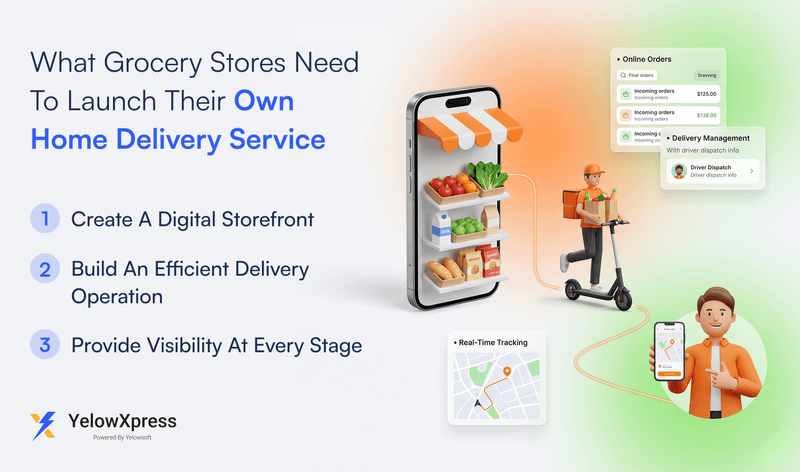
Launching a direct delivery operation is more achievable today than many retailers realize.
Create A Digital Storefront
Every delivery operation begins with an online ordering experience.
Customers should be able to browse products, search categories, view pricing, add items to cart, complete payments.
The process should feel simple.
If ordering becomes frustrating, customers will leave.
Build An Efficient Delivery Operation
Once orders begin arriving, execution becomes critical.
A reliable grocery delivery system should support driver assignment, delivery scheduling, route planning, delivery tracking, order monitoring.
Efficiency becomes increasingly important as order volume grows.
Provide Visibility At Every Stage
Customers dislike uncertainty. Real time updates reduce anxiety and build trust.
Notifications, tracking links, and delivery status updates create transparency throughout the journey.
Expert Tip:
Retailers often underestimate how much delivery visibility reduces support inquiries. Many businesses see noticeable decreases in customer service requests after implementing real time tracking.
How Grocery Delivery Software Helps Stores Operate Independently
Technology becomes the foundation of sustainable delivery operations.
Managing Orders Without Marketplace Dependence
Modern grocery delivery software allows grocery businesses to control their own ordering channels.
Instead of depending entirely on third party platforms, retailers can accept orders directly through their website or mobile app.
This provides greater control over pricing, promotions, and customer relationships.
Streamlining Deliveries Through Automation
As order volume increases, manual processes become difficult to manage.
This is where on demand grocery ordering software and on demand grocery delivery software create value.
Automation helps support driver allocation, route optimization, delivery scheduling, order monitoring, performance tracking.
The result is improved efficiency and reduced operational complexity.
Improving Customer Experience While Controlling Costs
Technology should not only improve operations.
It should improve the customer experience as well.
Benefits often include faster deliveries, better communication, higher order accuracy, lower operational costs, stronger customer retention.
These improvements compound over time.
Building A Delivery Model That Supports Long Term Growth
The objective is not simply replacing marketplace orders but to build a stronger business.
Encourage Repeat Orders
Direct ordering channels make loyalty initiatives easier to implement.
These may include loyalty programs, personalized discounts, subscription models, customer rewards.
The result is higher customer lifetime value.
Lower Customer Acquisition Costs
Businesses that own customer relationships can communicate directly through email, SMS, and app notifications.
This reduces reliance on expensive acquisition channels.
Over time, marketing becomes more efficient.
Scale Across Multiple Locations
Growth often introduces complexity.
Modern delivery platforms simplify expansion through multi store management, centralized reporting, inventory visibility, standardized workflows.
This makes growth easier to manage.
Expert Tip:
Before expanding into new service areas, focus on standardizing fulfillment processes. Consistent operations usually scale more successfully than inconsistent ones.
What The Future Looks Like For Grocery Home Delivery
The future of grocery retail is increasingly direct.
Customers want convenience. Businesses want profitability.
Fortunately, those goals are no longer mutually exclusive.
Technology continues making delivery operations easier to manage. Ordering systems are becoming smarter. Automation is becoming more accessible. Customer expectations are becoming clearer.
The grocery stores that invest in direct customer relationships today will likely have a significant advantage tomorrow.
Conclusion
Marketplace platforms helped grocery retailers enter online commerce.
There is no denying that.
However, as order volume grows, many businesses begin looking for ways to improve profitability, strengthen customer relationships, and reduce dependency on third parties.
The opportunity is substantial.
Consumers are already comfortable ordering groceries online. Many prefer purchasing directly from retailers rather than through aggregators.
By implementing grocery delivery software, grocery stores can build their own delivery ecosystem, manage operations more efficiently, and keep more revenue from every order.
The result is greater control, stronger customer loyalty, and a more sustainable path to growth.
Ready To Launch Home Delivery Without Marketplace Fees?
FAQ
Grocery stores can launch direct ordering websites and delivery operations using grocery delivery software, allowing them to manage orders, customers, and deliveries independently.
Grocery Delivery Software is a platform that helps grocery businesses manage online orders, delivery operations, customer communication, inventory visibility, and reporting from one system.
Yes. Direct ordering reduces commission expenses, improves customer ownership, increases repeat purchases, and helps grocery stores retain more revenue from every order.
A grocery delivery platform should include online ordering, delivery management, driver tracking, route optimization, customer notifications, inventory management, and analytics.
Yes. Cloud based grocery delivery software enables small and medium sized grocery stores to start delivery operations without significant infrastructure investments.
A grocery ordering system simplifies product discovery, online payments, order tracking, and communication, making the shopping experience faster and more convenient.
Customers prefer direct ordering because it often offers lower fees, better promotions, personalized service, and a more reliable shopping experience.