If you run a small restaurant, cloud kitchen, or ghost kitchen in the UK, you have likely faced this situation. Orders are coming in, but margins are getting tighter every month. Sales look healthy on the surface, yet profits tell a different story.
The reason is not lack of demand. The UK food delivery market is already worth more than £24 billion and continues to grow steadily. The issue lies elsewhere. Restaurants are losing between 10 to 30 percent of every order to aggregator commissions.
This creates a deeper problem. You gain visibility through platforms, but you lose control over your customers.
That is where the real shift begins.
The goal is not to stop using platforms like Just Eat. The goal is to build your own system where repeat customers order directly from you. This is where online ordering for small restaurants UK becomes a practical growth strategy, not just a technical upgrade.
Let us break this down clearly.
The UK Food Delivery Market Is Growing, But Margins Are Shrinking
The numbers tell a clear story. The UK online food delivery market exceeds £24 billion and is growing at around 7 to 8 percent annually. The broader ecosystem is expected to reach nearly $68 billion by 2035.
At first glance, this looks like a strong opportunity. Demand is rising. Customer adoption is high. Mobile ordering now accounts for nearly 75 percent of all food orders.
But growth is not evenly distributed.
Most of this demand is captured by aggregator platforms. Restaurants are participating in the market, but they are not controlling it.
Here is the real insight. Restaurants are not competing for demand. They are competing for ownership of that demand.
-
High demand does not guarantee profitability
-
Growth is platform-driven, not restaurant-driven
-
Dependency on aggregators increases over time
When your growth depends entirely on external platforms, your margins and customer relationships are always at risk.
Why Relying Only on Just Eat Is Costing You More Than You Think
Most restaurant owners focus on commission as the main cost. But the real impact runs deeper.
In the UK, Just Eat dominates the restaurant delivery market with capturing the market share of around 35–45%. The aggregator commissions typically range between 11 to 12%. In some cases, this goes higher depending on services.
Let us break it down simply.
A £25 order results in roughly £3 lost to commission. At 1,000 monthly orders, that becomes £3,000 in lost revenue.
Now extend this across a year. The numbers are significant.
But the bigger concern is not just the cost.
When orders come through aggregators, you do not own the customer relationship. You do not control their data. You cannot influence repeat behaviour directly.
You are also competing with dozens of similar restaurants on the same platform, often forced into pricing wars to stay visible.
The takeaway is simple. You are not just paying for orders. You are giving away long-term customer ownership.
Direct Orders vs Aggregators: Where Real Profit Lies
This is where the difference becomes measurable, not theoretical.
Data shows that direct orders generate up to 35% higher customer spend compared to aggregator platforms. That alone changes how you should look at your ordering strategy.
But the real distinction becomes clearer when you compare both models side by side.
| Factor | Aggregator Orders | Direct Orders |
|---|---|---|
| Profit Margin | Reduced due to 10–30% commission | Higher with no commission |
| Average Order Value | Lower basket size | Up to 35% higher spend |
| Customer Ownership | No access to customer data | Full access to customer data |
| Pricing Control | Limited, competitive pressure | Full control over pricing |
| Upselling Opportunities | Restricted | Flexible and customizable |
| Brand Experience | Shared with platform | Fully owned and branded |
| Long-Term Value | One-time transactions | Repeat business and loyalty |
This is why direct ordering is not just a cost-saving move. It is a revenue growth strategy.
When customers order directly, you are not only saving on commission. You are increasing order value, improving retention, and building a predictable revenue stream.
Expert Tip:
Track your average order value (AOV) separately for aggregator and direct channels. If your direct AOV is not at least 20–30% higher, optimize your menu structure, combos, and add-ons on your direct platform.
Customers Already Want to Order Direct. You Just Need to Capture Them
Many restaurant owners assume customers prefer aggregators. The data suggests otherwise.
Around 46 percent of UK consumers already order takeaway directly from restaurants. Among younger customers aged 16 to 34, this number goes up to nearly 79 percent.
This shows a clear pattern.
Customers are comfortable with direct ordering. The behaviour already exists. The problem is accessibility and convenience. If your ordering experience is slow, confusing, or not mobile-friendly, customers will default to aggregators.
Convenience is the deciding factor.
If your restaurant ordering website in UK experience matches or exceeds aggregator usability, customers are willing to switch.
The opportunity is not to create demand. It is to capture existing demand more effectively.
What Stops Small Restaurants from Getting More Direct Orders
The gap between aggregator orders and direct orders is not accidental. It is usually caused by operational and digital limitations.
Many small restaurants do not have a structured system in place.
They rely on basic websites that are not built for ordering. Customers cannot complete purchases easily. This leads to drop-offs.
In other cases, there is no clear strategy for repeat customers. Orders come in, but there is no mechanism to bring customers back.
Visibility is another challenge. Aggregators dominate search and discovery. Without a strong direct channel, restaurants struggle to attract customers independently.
Some common gaps include:
-
No mobile-optimized ordering system
-
No customer database or tracking
-
No direct promotions or loyalty programs
These are not technical issues alone. They directly affect revenue and customer retention.
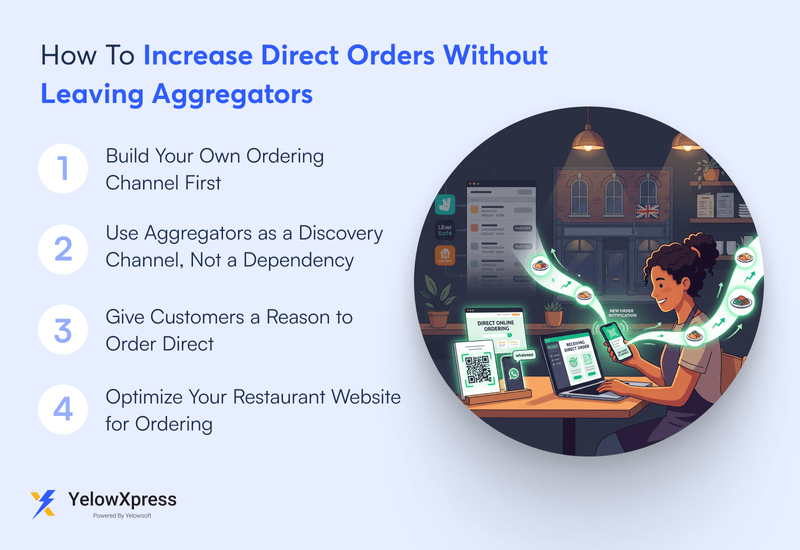
How to Increase Direct Orders Without Leaving Aggregators
This is where a balanced approach works best.
You do not need to abandon aggregators. You need to use them differently.
Build Your Own Ordering Channel First
Start with a dedicated ordering system that is simple, fast, and reliable.
It should work smoothly on mobile devices. Navigation should be clear. Checkout should take minimal steps.
Your goal is to match the convenience customers experience on aggregator apps.
This is where a small restaurant online ordering system in the UK becomes essential. It provides the structure needed to handle orders directly without friction.
Use Aggregators as a Discovery Channel, Not a Dependency
Aggregators are still valuable. They bring new customers.
But instead of relying on them for repeat orders, use them for discovery.
Once a customer places an order, guide them toward your direct channel. This can be done through packaging inserts, QR codes, or simple incentives.
Over time, this shifts behaviour gradually.
Give Customers a Reason to Order Direct
Customers need a clear benefit to switch.
This does not have to be complex.
-
Offer slightly better pricing than aggregator platforms
-
Provide exclusive deals for direct orders
-
Introduce loyalty rewards
These small changes can influence behaviour over time.
Expert Tip:
Run a controlled pricing test. Keep your aggregator menu slightly higher while offering better value on your direct ordering platform. Monitor order distribution over four weeks to measure impact without risking overall volume.
Optimize Your Restaurant Website for Ordering
Your website should not act as a digital brochure. It should function as a revenue channel.
Ensure fast loading speed. Keep the menu structured clearly. Make checkout simple.
A strong restaurant website ordering system setup reduces friction and increases conversions. Customers should be able to complete an order in under one minute.
That is the benchmark.
What to Look for in an Online Ordering System
Choosing the right system is critical. This is where online ordering for small restaurants in UK becomes a practical solution rather than a generic tool.
You need more than just order processing.
Look for a system that offers:
-
Commission-free ordering
-
Mobile-first experience
-
Integrated payment options
-
Full access to customer data
-
Easy menu and pricing control
Additional capabilities should include:
-
Real-time order tracking
-
Custom branding
-
Flexible delivery and pickup options
A well-built restaurant online ordering software in UK solution allows you to operate independently while maintaining control over your business.
Expert Tip:
Choose a system that integrates with customer analytics tools. Tracking repeat order frequency, average order value, and customer lifetime value gives you a measurable advantage in decision-making.
The Real Strategy: Reduce Dependency, Not Visibility
The most effective strategy is not to replace aggregators. It is to reposition them.
Aggregators are strong for acquiring new customers. Direct channels are essential for retaining them.
Think of it as a simple process.
Step 1: Acquire customers through aggregator platforms
Step 2: Convert them into direct customers
Step 3: Retain them through your own system
This approach creates balance.
You continue to benefit from platform visibility while building your own customer base. The restaurants that succeed in the long term are not the ones with the highest order volume. They are the ones who own their customer relationships.
This is where a direct food ordering platform UK becomes a strategic asset, not just an operational tool.
Conclusion
The UK food delivery market is expanding rapidly. Demand is not the issue. The challenge lies in control and profitability.
Aggregator platforms have made ordering convenient, but they come at a cost. Commissions reduce margins. Customer ownership remains outside your reach. At the same time, direct orders offer higher profitability, stronger customer relationships, and long-term stability.
The opportunity is clear.
You do not need to leave platforms like Just Eat. You need to build a system that allows you to capture and retain your customers directly.
If you want to move toward a commission free ordering system UK restaurants can depend on, you need a solution that gives you full control over your operations, your customers, and your growth.
Start getting more direct orders with Yelowxpress online ordering software built for small restaurants.
FAQs
It is a system that allows customers to place orders directly through a restaurant’s website or app. It helps restaurants avoid third-party commissions and build direct customer relationships.
It removes aggregator commissions, increases order value, and allows restaurants to upsell. Direct orders often result in better margins and improved customer retention.
Yes. Aggregators can be used for customer acquisition, while direct ordering platforms help retain customers and increase long-term profitability.
Customers tend to trust restaurant-owned platforms more and are more likely to add extra items. This leads to around 35 percent higher spending compared to aggregator orders.
It should include mobile-friendly design, payment integration, order tracking, customer data access, and flexible delivery options to ensure a smooth ordering experience.
You can use incentives such as discounts, loyalty rewards, and packaging inserts with QR codes to encourage customers to order directly next time.
Yes. It helps streamline operations, manage orders efficiently, and provide a better customer experience, which directly impacts repeat business and revenue.