Running a takeaway business has never been more competitive.
Customers have more choices, more ordering options, and higher expectations than ever before. At the same time, the cost of attracting new customers continues to rise.
Many restaurants, pizza stores, cloud kitchens, cafes, and food chains find themselves spending more on promotions, advertising, and third party delivery platforms just to maintain the same level of orders.
Research shows that acquiring a new customer can cost five to seven times more than retaining an existing one. Meanwhile, food delivery marketplaces often charge commissions ranging from 15% to 30% per order.
Existing customers spend 31% more than first time buyers on average, and studies from Bain & Company show that increasing customer retention by just 5% can increase profits by 25% to 95%.
These numbers reveal an important truth. Reducing customer acquisition cost is not simply about lowering marketing spend. It is about creating a system that encourages customers to order directly, return frequently, and build a long term relationship with your brand.
In this guide, you will learn why acquisition costs are rising, where takeaway businesses lose money, and how direct ordering, customer retention, and operational efficiency can help create sustainable growth.
Why Customer Acquisition Cost Is Rising for Takeaway Businesses
Before you can reduce customer acquisition costs, you need to understand why they continue to increase.
The takeaway industry has undergone a significant shift over the past decade. Digital ordering has become the norm, consumer expectations have increased, and competition has expanded far beyond local neighborhoods.
The Growing Competition for Digital Food Orders
Every day, more restaurants and food brands compete for the same online audience.
Paid advertising channels have become more expensive. Search results are crowded. Social media feeds are saturated with promotional offers.
Delivery platforms display hundreds of competing businesses within a small geographical area.
As competition grows, businesses often spend more money to generate the same number of orders.
How Marketplace Dependency Increases Acquisition Costs
Third party delivery platforms can help generate visibility, but they also create a dependency that affects profitability.
Commission charges, sponsored listings, promotional campaigns, and platform fees increase the cost of every order. More importantly, many businesses never truly own the customer relationship.
When customers order through a marketplace, the platform often controls communication and customer data. This means businesses may need to pay again to attract the same customer in the future.
The Hidden Costs Many Operators Overlook
Customer acquisition costs are not limited to advertising budgets.
Businesses often overlook:
-
Marketplace commissions
-
Discount campaigns
-
Sponsored placements
-
Customer recovery promotions
-
Lost customer ownership
| Acquisition Channel | Typical Cost Impact |
|---|---|
| Marketplace Commission | High |
| Paid Advertising | Medium to High |
| Direct Website Orders | Low |
| Existing Customer Orders | Lowest |
The more you rely on expensive acquisition channels, the harder it becomes to maintain healthy margins.
Understanding the Difference Between Acquisition and Retention
Many takeaway businesses focus heavily on attracting new customers while paying less attention to customers they already have.
That approach often creates unnecessary costs.
Why Retention Delivers Better Returns
Customer retention generally produces stronger long term returns because it reduces the need for continuous acquisition spending.
When customers return regularly marketing costs decrease, revenue becomes more predictable, profitability improves, brand loyalty strengthens.
Bain & Company found that a 5% increase in customer retention can increase profits by 25% to 95%.
That makes retention one of the most effective growth strategies available.
Existing Customers Are Often More Valuable
Existing customers already know your food quality, service standards, and ordering process.
They require less convincing.
Studies show that existing customers spend approximately 31% more than first time customers. They also tend to order more frequently and are more likely to recommend your business to others.
For a takeaway business, repeat customers often become the foundation of stable revenue growth.
Expert Tip:
Instead of measuring total orders alone, track your 90 day repeat purchase rate. This metric often reveals more about future profitability than daily sales figures.
How Direct Ordering Growth Reduces Customer Acquisition Costs
One of the most effective ways to reduce customer acquisition costs is to increase direct ordering growth.
When customers order directly from your business, you gain more control over the customer relationship and reduce recurring acquisition expenses.
What Direct Ordering Growth Really Means
Direct ordering can happen through your website, mobile apps, QR code ordering, social media order links.
The goal is simple. Move customer interactions closer to your brand instead of relying entirely on intermediaries.
Why Customer Ownership Matters
Owning customer relationships gives you access to valuable information.
You can understand ordering frequency, purchase preferences, customer lifetime value, reordering behavior.
This information helps create more targeted marketing campaigns and stronger retention programs.
The Long Term Economics of Direct Orders
| Metric | Marketplace Orders | Direct Orders |
|---|---|---|
| Commission Fees | High | Low |
| Customer Data Access | Limited | Full |
| Retention Opportunities | Limited | Strong |
| Profit Margin | Lower | Higher |
This is where online ordering becomes particularly valuable.
Rather than paying commissions repeatedly, businesses can create direct relationships that improve margins over time.
Building a Repeat Order Engine Instead of a One Time Purchase Funnel
The most efficient customer acquisition strategy often begins after the first order.
Businesses that encourage repeat purchases typically reduce acquisition costs faster than those constantly chasing new customers.
Loyalty Programs That Encourage Repeat Orders
Loyalty programs create incentives for customers to return.
Popular approaches include points systems, cashback rewards, exclusive discounts, VIP memberships.
McKinsey research indicates that loyalty members generate 12% to 18% higher annual revenue than non members.
Personalized Communication Drives Reorders
Communication remains one of the most underutilized retention tools.
Email campaigns, SMS notifications, and app messages help businesses stay connected with customers after the initial purchase.
According to Litmus, email marketing generates an average return of $36 for every $1 spent.
That makes it one of the most cost effective customer retention channels available.
Creating Habit Based Ordering Behavior
Many successful takeaway businesses create predictable ordering habits.
Examples include weekly family meal offers, friday pizza promotions, lunch subscription plans, office catering packages.
The goal is to become part of a customer's routine rather than an occasional purchase.
Improving Customer Experience to Lower Acquisition Costs
Many acquisition challenges actually originate from customer experience issues.
When experiences improve, customers return more frequently and recommend your business to others.
Faster Ordering Experiences Increase Conversion
Customers expect convenience.
A complicated ordering process often results in abandoned carts and lost revenue.
Simple ordering experiences typically include mobile optimized interfaces, faster checkout, saved payment methods, simple menu navigation.
These improvements directly affect conversion rates.
Delivery Visibility Builds Trust
Customers dislike uncertainty.
They want to know when food will arrive and where their order currently is.
Providing delivery visibility through tracking and status updates improves confidence and reduces support inquiries.
Reviews Influence Future Acquisition Costs
Research shows that 93% of consumers read online reviews before making purchasing decisions.
Positive reviews act as unpaid marketing.
Strong ratings reduce acquisition costs because new customers arrive with greater trust and confidence.
Expert Tip:
Monitor customer reviews by order source. You may discover that certain acquisition channels generate lower retention rates and higher service complaints.
The Role of Online Ordering and Delivery Management in Sustainable Growth
Technology can significantly influence customer acquisition efficiency.
The right systems improve customer experiences while reducing operational waste.
How Online Ordering Creates Better Customer Journeys
A well designed online ordering experience reduces friction.
Customers can browse menus, customize items, complete payments, and reorder quickly.
That convenience improves conversion and retention.
Why Delivery Management Impacts Acquisition Costs
Delivery Management affects much more than logistics.
Reliable delivery operations contribute directly to customer satisfaction, positive reviews, repeat orders, brand reputation.
Poor delivery experiences often increase acquisition costs because businesses must continuously replace dissatisfied customers.
Using Data to Improve Retention
Modern systems provide access to valuable operational insights.
Businesses can track purchase history, average order value, order frequency, customer lifetime value.
These insights support smarter retention strategies and more efficient marketing decisions.
Managing Growth Across Multiple Locations Without Increasing CAC
Expansion creates new opportunities, but it can also create new acquisition challenges.
How Multi Outlet Management Supports Consistency
Multi outlet management helps businesses maintain consistent service across locations.
Consistency strengthens customer trust and improves brand recognition.
Customers expect the same experience regardless of where they place an order.
Maintaining Loyalty Across Locations
Businesses that centralize customer profiles create better experiences.
Benefits include shared loyalty rewards, unified customer accounts, consistent promotions.
This helps strengthen long term customer relationships.
Scaling Operations Efficiently
Growth should not require proportionally higher acquisition spending.
The most successful operators improve operational efficiency while strengthening customer retention.
Expert Tip:
Track customer lifetime value by outlet location. This often identifies high performing locations that deserve greater marketing investment.
Practical Ways to Reduce Customer Acquisition Costs Today
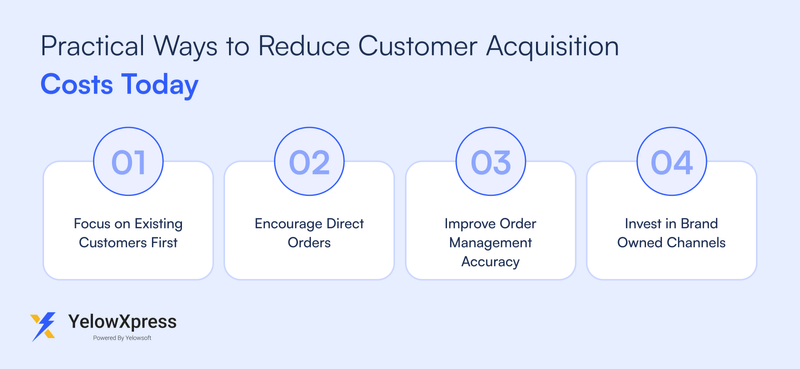
Reducing customer acquisition costs does not require a complete business overhaul.
Several practical improvements can produce measurable results.
Focus on Existing Customers First
Review inactive customers and create re-engagement campaigns before increasing acquisition budgets.
Encourage Direct Orders
Offer incentives that encourage customers to order directly rather than through marketplaces.
Research shows that more than 70% of consumers prefer ordering directly when meaningful rewards are available.
Improve Order Management Accuracy
Strong order management processes reduce mistakes, complaints, and refunds.
Accurate fulfillment improves customer satisfaction and increases repeat orders.
Invest in Brand Owned Channels
White label ordering & delivery apps provide greater control over branding, customer relationships, and marketing opportunities.
They also reduce dependency on expensive third party acquisition channels.
Conclusion
Customer acquisition costs are increasing across the takeaway industry, but that does not mean profitability has to decline.
The businesses that succeed are not always the ones spending the most on advertising. They are often the businesses that focus on customer retention, direct relationships, operational efficiency, and long term loyalty.
When you reduce dependency on marketplaces, strengthen customer experiences, improve online ordering, and optimize delivery management, you create a more sustainable growth model.
The opportunity is not simply to acquire more customers. The opportunity is to keep more of the customers you already earn.
That approach lowers acquisition costs, improves margins, and builds a stronger foundation for long term success.
Reduce Acquisition Costs. Increase Direct Orders.