Consumer expectations have changed significantly over the last few years.
Your customers no longer want to wait days to receive food, groceries, medicines, retail products, or everyday essentials. They expect convenience, speed, transparency, and real time updates throughout the entire buying journey.
As a result, on demand delivery has evolved from a competitive advantage into a critical business capability.
Whether you operate a restaurant, grocery store, pharmacy, retail business, or delivery startup, your ability to fulfill orders quickly and efficiently directly impacts customer satisfaction, retention, and revenue growth.
Businesses that fail to meet these expectations often struggle to compete with digitally enabled competitors that provide faster and more convenient delivery experiences.
In this guide, you will learn what on demand delivery is, how it works, its benefits and challenges, the technologies powering it, future industry trends, and how businesses can successfully scale delivery operations in 2026.
Let's get into it!
What Is On Demand Delivery?
On demand delivery refers to a fulfillment model where products or services are delivered shortly after a customer places an order. Depending on the business model, delivery may occur within hours, the same day, or within a predefined delivery window.
Unlike traditional delivery systems that often rely on fixed schedules and longer fulfillment times, on demand delivery prioritizes speed, convenience, and real time responsiveness.
Today, on demand delivery is widely used across:
-
Restaurants
-
Grocery stores
-
Pharmacies
-
Retail businesses
-
Courier companies
-
Local service providers
At its core, the goal of on demand delivery is simple: connect customers with products as quickly and efficiently as possible while maintaining visibility throughout the delivery journey.
Traditional Delivery vs On Demand Delivery
The key difference between traditional and on-demand delivery:
| Traditional Delivery | On Demand Delivery |
|---|---|
| Fixed delivery schedules | Real time order fulfillment |
| Longer delivery windows | Faster delivery times |
| Limited customer visibility | Live delivery tracking |
| Manual coordination | Automated dispatching |
| Lower operational flexibility | Dynamic and scalable operations |
The difference is becoming increasingly important because customer expectations continue to rise.
How Does On Demand Delivery Work?
Although customers experience a simple ordering process, multiple systems work together behind the scenes to ensure successful delivery.
Here’s a step by step breakdown:
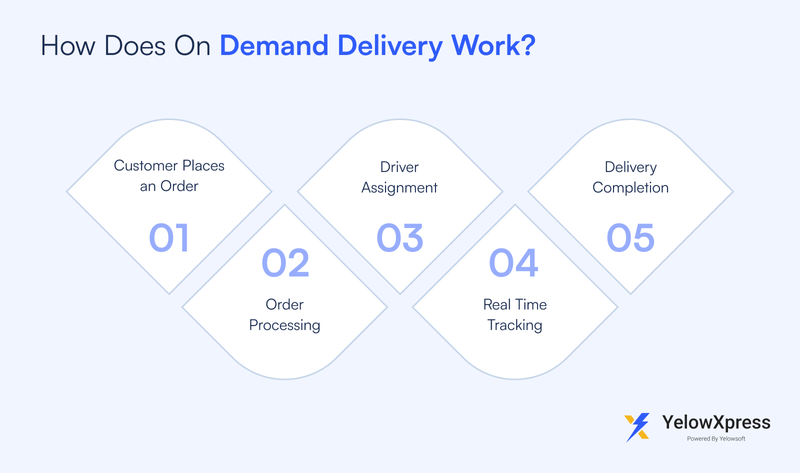
Step 1: Customer Places an Order
The process begins when a customer places an order through:
-
Mobile applications
-
Self ordering kiosks
-
Social commerce channels
The order is instantly transmitted to the business.
Step 2: Order Processing
The business receives the order and begins fulfillment.
-
Restaurants prepare food.
-
Grocery stores pick products.
-
Pharmacies process prescriptions.
-
Retail businesses prepare items for dispatch.
Step 3: Driver Assignment
The delivery platform automatically identifies the most suitable driver based on: current location, availability, delivery zone, vehicle type, and order priority
Modern delivery operations increasingly rely on automated dispatching rather than manual allocation.
Step 4: Real Time Tracking
Customers receive updates including:
-
Order confirmation
-
Driver assignment
-
Estimated arrival time
-
Live tracking status
This transparency improves customer confidence and reduces support inquiries.
Step 5: Delivery Completion
The driver delivers the order, confirms completion, and the customer receives the product.
Plus, many businesses also collect feedback, ratings, and proof of delivery information at this stage.
Why On Demand Delivery Is Growing So Fast in 2026
Several market trends continue to drive adoption across industries.Here are the key reasons why on demand delivery is glowing so fast in 2026.
Rising Consumer Expectations
Customers increasingly expect deliveries to happen quickly and conveniently. According to Statista, global online food delivery revenue is expected to exceed $1.40 trillion in 2026. Source:
This growing demand creates pressure on businesses to improve fulfillment capabilities.
Growth of Mobile Commerce
Consumers now place orders directly from smartphones, creating a need for systems capable of processing and fulfilling orders instantly.
Hyperlocal Delivery Expansion
Businesses are moving inventory closer to customers through dark stores, local fulfillment centers, and distributed delivery networks.
Demand for Customer Ownership
Businesses increasingly want direct relationships with customers rather than depending entirely on third party marketplaces.
Expert Tip:
Businesses that own their ordering channels often gain stronger customer retention because they control the customer experience, communication, and loyalty programs from end to end.
Industries Using On Demand Delivery
On demand delivery is no longer limited to food delivery businesses. The major industries using on demand delivery:
Restaurants
Restaurants use on demand delivery to accept direct online orders, improve customer convenience, increase repeat business, and reduce dependency on aggregators
Grocery Stores
Grocery businesses use delivery systems for:
-
Same day fulfillment
-
Scheduled deliveries
-
Inventory management
-
Multi store operations
Pharmacies
Pharmacies rely on delivery platforms to manage:
-
Prescription deliveries
-
Refill requests
-
Customer notifications
-
Compliance requirements
Retail Businesses
Retailers increasingly use local delivery to compete with large ecommerce platforms and provide faster customer service.
Courier and Parcel Companies
Delivery management systems help courier businesses improve route planning, driver productivity, and delivery visibility.
Benefits of On Demand Delivery
On demand delivery has benefits beyond its the key features. The top benefits of on demand delivery include:
Faster Order Fulfillment: Businesses can process and deliver orders more efficiently, helping customers receive products when they need them.
Better Customer Experience: Customers value speed, transparency, convenience, and reliability. These factors contribute directly to customer satisfaction.
Increased Customer Retention: Satisfied customers are more likely to return and place additional orders.
Improved Operational Visibility: Managers gain access to real time information about orders, drivers, deliveries, and performance metrics.
Revenue Growth Opportunities: Faster and more reliable deliveries often translate into higher order volumes and stronger customer loyalty.
Common Challenges in On Demand Delivery
Despite its advantages, on demand delivery introduces several operational challenges. The challenges that may affect on demand delivery are:
Driver Availability: Finding enough drivers during peak periods can become difficult.
Delivery Delays: Traffic conditions, route inefficiencies, and poor coordination can negatively impact service quality.
Failed Deliveries: Incorrect addresses and unavailable customers can increase delivery costs.
Managing High Order Volumes: Many businesses struggle once delivery volumes begin increasing rapidly.
Limited Visibility: Without centralized delivery management, identifying operational bottlenecks becomes challenging.
However, all these challenges can be easily overcome with the right on-demand delivery software.
Technologies Powering Modern On Demand Delivery
Successful delivery operations depend heavily on technology.
AI Based Dispatching: Artificial intelligence helps allocate deliveries more efficiently based on real time conditions.
Route Optimization: Advanced routing reduces delivery times, fuel costs, and driver idle time.
Delivery Orchestration: Delivery orchestration connects ordering channels, fulfillment teams, dispatch systems, and drivers into a unified workflow.
Real Time Tracking: Customers increasingly expect visibility throughout the delivery process.
Analytics and Reporting: Businesses use analytics to measure delivery performance, customer behavior, operational efficiency, and revenue trends.
How Businesses Scale Beyond 50 Orders Per Day
Growth creates new operational requirements.
Manual processes that work for small delivery volumes often fail at larger scales.
Businesses typically scale successfully by:
-
Centralizing order management
-
Automating dispatching
-
Managing multiple locations from one platform
-
Tracking driver performance
-
Monitoring delivery metrics
Expert Tip:
The most successful delivery businesses standardize processes before scaling operations. Growth without operational structure often creates delays, errors, and inconsistent customer experiences.
Future Trends Shaping On Demand Delivery
The future of on demand delivery will be driven by technology and changing customer expectations.
Key trends include:
-
AI powered delivery operations
-
Predictive dispatching
-
Hyperlocal fulfillment
-
Dark store expansion
-
Delivery orchestration platforms
-
Unified commerce ecosystems
-
Enhanced customer visibility
Businesses that invest in these capabilities today will be better positioned for long term growth.
Conclusion
On demand delivery is no longer limited to food delivery or quick commerce. It has become a critical business capability for restaurants, grocery stores, pharmacies, retail businesses, and delivery startups that want to meet modern customer expectations.
Customers now expect convenience, speed, real time visibility, and flexible fulfillment options as part of their everyday buying experience.
As delivery demand continues to grow, businesses must move beyond manual processes and disconnected systems.
Successfully managing orders, drivers, routes, inventory, and customer communication requires a technology driven approach that supports both operational efficiency and business growth.
Companies that invest in automation, delivery orchestration, and customer focused delivery experiences will be better positioned to improve retention, increase order volumes, and maintain a competitive advantage.
If your business is planning to launch, optimize, or scale delivery operations, YelowXpress's On Demand Delivery Software Solution provides everything needed to manage online ordering, delivery orchestration, driver operations, real time tracking, and customer communication from a single platform.
It helps businesses build a reliable, scalable, and branded delivery ecosystem designed for long term growth.
Ready to Turn Delivery Operations Into a Competitive Advantage?
FAQs
On demand delivery is a fulfillment model that enables businesses to deliver products shortly after an order is placed. It combines online ordering, delivery management, driver coordination, and real time tracking to provide faster and more convenient customer experiences.
On demand delivery works through a connected system where customers place orders online, businesses process them, drivers are automatically assigned, and deliveries are tracked in real time. The entire process is managed through delivery management software.
Restaurants, grocery stores, pharmacies, retail businesses, and courier companies benefit significantly from on demand delivery. It helps improve fulfillment speed, customer satisfaction, operational visibility, and overall delivery efficiency.
Successful on demand delivery operations typically require online ordering software, delivery management systems, driver apps, route optimization, real time tracking, automated dispatching, and analytics tools to manage deliveries efficiently.
Common challenges include delivery delays, driver availability, failed deliveries, route inefficiencies, and managing high order volumes. Modern delivery orchestration and automation tools help businesses overcome these operational obstacles.
Businesses can scale on demand delivery by centralizing order management, automating dispatching, optimizing delivery routes, tracking performance metrics, and using delivery software that supports multi location operations and growing order volumes.