Most pizza businesses spend a large part of their budget trying to bring in new customers. New ads, discounts, aggregator promotions, and paid visibility all focus on getting the next order.
But sustainable growth rarely comes from first-time buyers.
It comes from the customer who orders every Friday night. The office team that places the same lunch order every week. The family that trusts your store without comparing five other options first.
That is where real profitability lives.
When ordering feels simple, delivery is accurate, and the customer feels remembered, reordering becomes automatic. It stops being a decision and becomes a habit.
This is where pizza delivery software becomes much more than an operational tool.
It improves repeat orders by reducing friction across ordering, dispatching, delivery, loyalty, and customer communication. From faster checkout to personalized offers and loyalty rewards, the right system helps build stronger customer relationships.
Across the USA, UK, and Australia, pizza brands are investing in better systems because repeat business is what drives long-term revenue.
Why Repeat Orders Matter More Than New Customers
Retention Creates Predictable Revenue
A first-time customer gives you one sale.
A repeat customer gives you business stability.
For pizza stores, predictable revenue matters more than occasional spikes. Staff planning, inventory control, delivery efficiency, and marketing decisions all improve when order frequency becomes reliable.
Instead of constantly spending to replace lost customers, businesses with stronger retention grow from an existing customer base.
That creates healthier margins and lower acquisition pressure.
Pizza Customers Already Follow Repeat Buying Habits
Pizza is one of the few food categories built around repeat behavior.
Industry data shows customers reorder pizza every 9.85 days on average . That means the opportunity already exists.
The challenge is not convincing people to like pizza.
The challenge is making sure they come back to your store instead of choosing another app or brand next time.
Frequent Buyers Improve Profit Margins
Repeat customers usually spend more over time and require less marketing effort.
They are more likely to trust upsells, try combos, and respond to loyalty offers. They also complain less about pricing because the relationship is already established.
This improves customer lifetime value and reduces dependence on aggressive discounting.
Strong Retention Reduces Growth Pressure
When repeat revenue is healthy, businesses do not rely entirely on aggregators or constant paid campaigns.
That gives operators more control over margins and long-term planning.
Instead of chasing traffic, they build habits.
That is the difference between surviving and scaling.
Faster Ordering Creates Better Repeat Behavior
Easy Ordering Removes Customer Hesitation
People reorder from the place that feels easiest.
If checkout takes too long, payment fails, or the process feels confusing, customers simply leave.
A strong pizza ordering system removes this friction with saved addresses, quick checkout, secure payment methods, and a smoother mobile experience.
The goal is simple: fewer steps between hunger and order confirmation.
Mobile-First Ordering Increases Convenience
Most repeat purchases happen during busy moments.
Customers are ordering from work, while commuting, or during family dinner hours. They want speed, not complexity.
That is why mobile-first design matters.
Your pizza ordering software should make ordering effortless on mobile devices, not just functional.
If the mobile experience feels slow, repeat intent drops fast.
One-Click Reorder Supports Habitual Buying
Most repeat buyers are not looking for variety every time.
They want the same large pepperoni, same garlic bread, same Friday routine.
One-click reorder helps customers repeat previous purchases instantly. It removes decision fatigue and supports natural repeat behavior.
This is a small feature with major retention impact.
Online Ordering Improves Average Order Value
Studies show online pizza ordering increases average order value by 18% .
Why?
Because customers can clearly see menu upgrades, add-ons, combo deals, and customizations.
That improves both revenue per order and the frequency of return visits.
Expert Tip:
Track reorder completion rate, not just total orders.
If customers start an order but abandon before checkout, your friction usually exists in payment flow, delivery charges, or checkout complexity. This metric reveals repeat-order problems early.
Delivery Speed Directly Impacts Customer Loyalty
Faster Delivery Builds Customer Trust
Customers remember delays longer than they remember discounts.
A good pizza delivered late still feels like bad service.
Reliable delivery speed creates trust. Customers start believing your promised timing, and that confidence drives repeat orders.
Trust is often built in minutes, not marketing.
Even Small Delivery Improvements Matter
Reducing delivery time by just 5 minutes can increase repeat rates by 10% .
That is a major business impact from a very small operational improvement.
For pizza businesses, delivery speed is not just an operations metric. It is a retention metric.
Smart Dispatch Reduces Avoidable Delays
This is where pizza delivery management software becomes critical.
Automatic driver assignment, delivery zone rules, route optimization, and dispatch prioritization reduce delays caused by manual decision-making.
Instead of dispatchers managing chaos, the system creates consistency.
That consistency directly improves customer loyalty.
Real-Time Tracking Improves Customer Confidence
Customers do not just want fast delivery.
They want visibility.
Real-time tracking and accurate ETA updates reduce anxiety and lower support calls. When customers know where their order is, frustration drops significantly.
Transparency builds trust even when delivery takes longer than expected.
Personalization Encourages Customers to Return
Saved Preferences Make Reordering Easier
Customers should not rebuild the same order every time.
Saved toppings, preferred addresses, favorite items, and previous order history make repeat ordering faster and easier.
Convenience is often stronger than pricing when it comes to loyalty.
People return to what feels familiar.
Order History Improves Customer Experience
A good system remembers customer behavior.
It knows what they ordered, when they ordered it, and what patterns exist over time.
This helps create a more personal experience without manual effort.
That familiarity increases repeat confidence.
CRM Supports Smarter Follow-Up Campaigns
Customer data should lead to action.
If someone orders every Saturday and suddenly stops, your CRM should trigger a reminder. If a customer frequently buys family meals, relevant bundle offers should follow.
This is where strong pizza ordering and delivery software becomes a retention engine instead of just a delivery platform.
AI-Powered Support Improves Retention
A global pizza chain increased repeat orders by 15% using AI-powered IVR, CRM integration, and cloud telephony .
Faster support, fewer missed calls, and smarter follow-ups created stronger customer loyalty.
Support speed often decides whether a customer returns after one bad experience.
Loyalty Features Turn One-Time Buyers Into Regular Customers
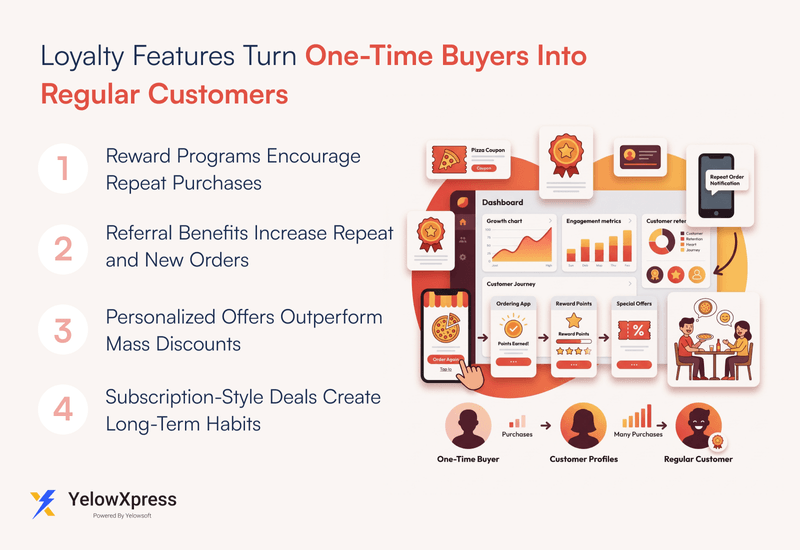
Reward Programs Encourage Repeat Purchases
Customers stay loyal when there is a reason to stay.
Points, cashback, loyalty credits, and exclusive member offers create repeat motivation.
Instead of asking “Where should I order tonight?” customers already know the answer.
That is the real purpose of loyalty systems.
Referral Benefits Increase Repeat and New Orders
Referral programs create two advantages at once.
They bring new customers and strengthen the relationship with existing ones.
When customers are rewarded for recommending your store, they become part of your growth strategy.
Personalized Offers Outperform Mass Discounts
Giving everyone the same discount hurts margins.
Smarter offers based on order history work better.
For example, sending a weekday combo offer to a weekend-only buyer is more effective than running a blanket 20% discount.
Retention improves without unnecessary revenue loss.
Subscription-Style Deals Create Long-Term Habits
Weekly pizza plans, family meal subscriptions, or membership-based offers help turn occasional customers into regular buyers.
This creates predictable demand and stronger revenue forecasting.
Expert Tip:
Build loyalty offers around reorder timing, not calendar dates.
If your average customer reorders every 10 days, send rewards on day 8 or 9. Timing based on behavior performs better than generic monthly promotions.
Better Communication Builds Long-Term Trust
Live Order Tracking Reduces Customer Anxiety
Customers want visibility, not silence.
Live delivery tracking improves confidence because customers know exactly what is happening.
It reduces frustration, cuts support calls, and improves the post-purchase experience.
ETA Updates Improve Transparency
Delayed deliveries are less damaging when customers are informed early.
Accurate ETA updates and proactive delay alerts show professionalism and improve trust.
Silence creates frustration. Communication protects loyalty.
Contactless Ordering Supports Modern Expectations
In Australia, 87% of users prefer contactless online ordering because it feels faster and easier .
Convenience now shapes customer expectations, especially for repeat buyers.
Modern ordering behavior is built around speed and simplicity.
Fast Support Protects Customer Relationships
Mistakes happen in every business.
Wrong toppings, late deliveries, or payment issues are unavoidable at scale.
What matters is how quickly the issue gets solved.
Fast support often decides whether the customer gives you another chance.
Direct Ordering Helps You Own Repeat Revenue
Aggregators Bring Visibility, Not Ownership
Third-party apps help you get discovered.
But they often keep the customer relationship for themselves.
You pay the commission, but the loyalty belongs to the platform.
That creates long-term dependency.
Customer Data Should Belong to Your Business
Without access to customer behavior, improving retention becomes difficult.
You cannot personalize offers, track reorder frequency, or build loyalty if the platform owns the data.
Direct ordering solves that problem.
Better Margins Support Stronger Loyalty Strategies
Reducing aggregator commissions creates room for better service and stronger retention investments.
That budget can go into loyalty programs, faster delivery, and customer support instead of platform fees.
Strong Brands Use Aggregators for Discovery Only
Smart operators use aggregators to acquire customers and their own pizza delivery software to retain them.
This creates a sustainable balance between visibility and ownership.
Expert Tip:
Use aggregator orders to capture direct reorder opportunities.
Include QR codes, loyalty prompts, or next-order benefits inside delivery packaging to move customers from marketplace dependency to direct ordering.
What to Look for in Modern Pizza Delivery Software
Online Ordering Should Be Seamless
Customers should be able to order through websites, branded apps, and direct digital channels without friction.
The easier the journey, the stronger the retention.
Dispatch and Delivery Management Must Be Intelligent
A reliable pizza delivery management software solution should include smart routing, driver assignment, delivery tracking, and operational automation.
This improves consistency and repeat trust.
CRM and Loyalty Tools Should Be Built In
Retention depends on customer history, reward systems, personalized offers, and re-engagement campaigns.
These should not be separate tools.
They should work inside the same platform.
Analytics Should Track Repeat Customer Behavior
Good software should not only show delivery reports.
It should help you understand reorder frequency, customer value, repeat purchase gaps, and retention opportunities.
That is how growth becomes measurable.
Conclusion
Repeat orders are built through consistency, convenience, and trust.
Customers return when ordering feels easy, delivery feels reliable, and the brand remembers their preferences.
That does not happen through manual operations alone.
It requires the right pizza delivery software working across ordering, dispatch, CRM, loyalty, and customer communication.
Whether you run one pizza store or manage multiple locations, repeat business should be treated as a system, not a short-term campaign.
The right platform helps you move from constantly chasing new customers to building predictable recurring revenue.
That is where YelowXpress helps, giving pizza businesses the tools to reduce aggregator dependence, improve customer retention, and turn first-time buyers into loyal long-term customers through a smarter delivery experience.
Turn First Orders Into Repeat Revenue.