If you run a restaurant in the UK, you are already seeing the shift. Orders are increasing, but margins are tightening.
The UK food delivery market is expected to reach £14.3 billion in 2025, showing steady growth, yet much of this revenue flows through third-party platforms that charge high commissions (Lumina Intelligence).
At the same time, consumer behavior is evolving. Around 40% of diners now prefer ordering directly from restaurant websites or apps, signalling a clear move toward direct engagement
This creates a difficult position. You are generating demand, but you do not fully own the customer relationship. Platforms control visibility, pricing pressure, and access to data. Over time, this limits your ability to build loyalty and scale profitably.
Now, a structural shift is underway. Restaurants across the UK are moving toward direct-to-customer food ordering, not as a trend but as a strategy to regain control over margins, branding, and customer data.
In this article, you will understand how the UK food delivery market is evolving, the challenges of aggregator dependence, and why direct ordering is becoming the foundation for sustainable restaurant growth.
Let’s get started!
The UK Food Delivery Market Is Changing Fast
This section explains how the current market dynamics are shaping restaurant decisions.
Growing Dependence on Aggregators
Restaurants across the UK have increasingly relied on third-party platforms to generate orders. These platforms provide access to a large customer base and simplify logistics. For new businesses, they often act as a quick way to enter the market.
However, as reliance grows, control decreases. When most of your orders come from external platforms, your business becomes dependent on their ecosystem.
This creates a situation where growth is tied to platform visibility rather than your own strategy.
Rising Costs and Margin Pressure
Commission fees remain one of the biggest concerns. Restaurants often pay between 15% and 35% per order. Over time, this significantly impacts profitability.
When you combine these fees with operational costs such as staffing, ingredients, packaging, and delivery, the margins become extremely tight. Many businesses find themselves working harder without seeing proportional returns.
Customer Ownership Is Being Lost
One of the most critical issues is the loss of customer ownership. When orders are placed through third-party platforms, the data belongs to the platform, not the restaurant.
This means you cannot:
-
Build direct relationships
-
Retarget customers
-
Personalize offers
Without access to this data, long-term growth becomes difficult.
Shift Toward Digital Independence
As these challenges grow, restaurants are actively looking for alternatives. The focus is shifting toward systems that allow businesses to regain control over their operations.
This is where restaurant online ordering system UK designed for direct ordering becomes important. It enables restaurants to manage orders, customers, and delivery from their own platform.
The Hidden Problems with Aggregator-Driven Ordering Models
Understanding the deeper issues helps you see why change is necessary.
High Commission Cuts Reduce Profit Margins
Every order placed through an aggregator reduces your earnings. Even if order volume increases, profitability does not always follow.
No Direct Relationship with Customers
Customers often associate their experience with the platform rather than the restaurant. This weakens your brand identity and reduces repeat business.
Limited Control Over Branding and Experience
You have limited flexibility in how your restaurant is presented. Menu design, promotions, and communication are influenced by platform rules.
Data Lock-In and Dependency Risks
Since platforms control customer data, shifting away from them becomes difficult. This creates long-term dependency.
Price Competition and Visibility Challenges
Restaurants compete for visibility within the platform. This often leads to discounts and price-based competition, which further reduces margins.
Expert Tip:
If your marketing strategy depends entirely on aggregator visibility, your growth is externally controlled.
What Is Direct-to-Customer Food Ordering?
Direct-to-customer food ordering is a system where customers place orders directly with your restaurant using your own digital channels, without relying on third-party marketplaces.
These channels typically include:
-
Your branded website
-
Your mobile app
-
QR-based ordering links
-
In-store digital kiosks
In this model, you control how orders are received, processed, and fulfilled.
How It Works (Simple Flow)
Customer → Your website/app → Order placed → Kitchen processes → Delivery → Feedback
There is no intermediary platform between you and your customer. Every interaction happens within your ecosystem.
How It Differs from Aggregator-Based Ordering
| Aspect | Aggregator Model | Direct-to-Customer Model |
|---|---|---|
| Order Channel | Third-party apps | Your own platform |
| Customer Data | Platform-controlled | Fully owned by you |
| Branding | Standardized | Fully customizable |
| Profit Margins | Reduced by commissions | Higher retention |
| Customer Relationship | Indirect | Direct and ongoing |
Core Components
A complete online food ordering software UK for direct ordering is not just a checkout page. It includes:
-
Ordering interface (website or app)
-
Order management system (for tracking and processing)
-
Kitchen integration (to manage preparation flow)
-
Delivery management (driver assignment and tracking)
-
Customer communication tools (notifications, feedback, offers)
Expert Tip:
Think of direct ordering as your restaurant’s digital storefront. The more control you have over it, the stronger your long-term growth becomes.
Direct Ordering vs Aggregators: A Practical Comparison
Here is a quick comparison between direct ordering and aggregators that highlights the long-term impact.
| Factor | Aggregator Platforms | Direct Ordering System |
|---|---|---|
| Commission Fees | High (15–35%) | None or minimal |
| Customer Data | Owned by platform | Owned by business |
| Branding | Limited | Fully customizable |
| Profit Margins | Lower | Higher |
| Customer Loyalty | Platform-driven | Brand-driven |
| Long-term Growth | Restricted | Scalable |
How UK Restaurants Can Transition to Direct Ordering
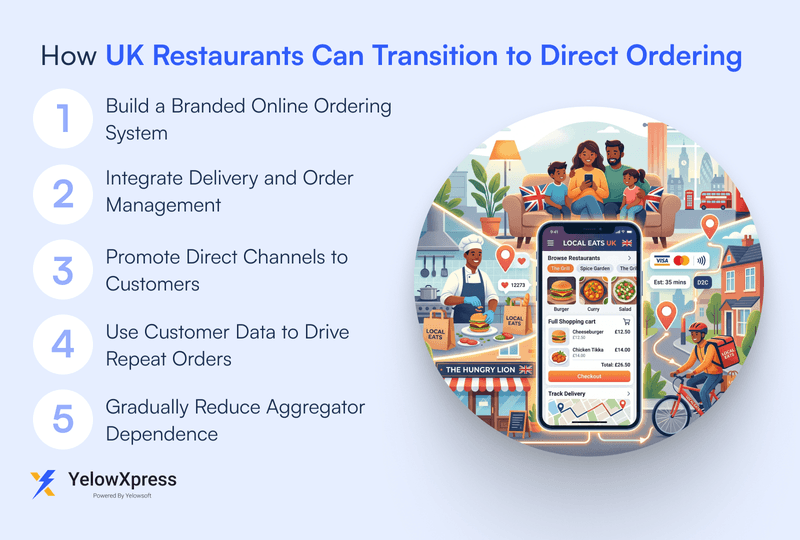
Now let's look at a practical path you can follow to move from dependency to control, step by step:
Step 1: Build a Branded Online Ordering System
Start by setting up your own website and mobile app where customers can place orders directly. This becomes your primary digital storefront, fully aligned with your brand and menu.
Step 2: Integrate Delivery and Order Management
Connect your ordering system with kitchen operations and delivery workflows. This ensures every order is processed smoothly, tracked in real time, and fulfilled without delays.
Step 3: Promote Direct Channels to Customers
Encourage customers to order directly by offering better value through your platform. Use packaging inserts, QR codes, and exclusive deals to shift behavior gradually.
Step 4: Use Customer Data to Drive Repeat Orders
Capture and use customer data to understand preferences and ordering patterns. This allows you to send targeted offers and build long-term relationships.
Step 5: Gradually Reduce Aggregator Dependence
Do not remove aggregators immediately. Use them as a support channel while steadily increasing orders through your own platform, thereby creating a balanced transition.
Key Features to Look for in a Direct Ordering Platform
Choosing the right direct ordering platform for restaurants UK determines how effectively you can scale and manage your operations. Focus on features that directly improve customer experience and operational control.
Seamless Online Ordering Experience
Your platform should make ordering simple, fast, and intuitive across devices. A smooth checkout process reduces drop-offs and improves conversion rates.
Real-Time Order and Delivery Tracking
You and your customers should have clear visibility into order status at every stage. This builds trust and helps you respond quickly to delays or issues.
Multi-Outlet and Menu Management
If you operate multiple locations, the system should allow centralized control with outlet-level customization. This ensures consistency while maintaining flexibility.
Integrated Payment and Checkout
Support for secure, flexible payment options is essential for customer convenience. A streamlined checkout reduces friction and increases completed orders.
Analytics and Reporting Dashboard
Access to real-time data helps you track performance, identify trends, and make informed decisions. This is critical for improving efficiency and profitability.
White-Label Branding Capabilities
The platform should fully reflect your brand identity, from design to communication. This ensures customers interact with your business, not a third-party system.
Conclusion
The UK food delivery landscape has reached a stage where growth without control no longer works.
While third-party platforms helped you get discovered, they also limit your margins, restrict access to customer data, and reduce your ability to build long-term relationships. If you want sustainable growth, you need to move beyond dependency.
Direct ordering gives you that control. It allows you to manage your pricing, own your customer data, and create a consistent brand experience that drives repeat business. This is not just an operational upgrade. It is a strategic shift that strengthens your position in a competitive market.
To make this shift effective, you need more than just a basic tool. With YelowXpress’s Online food ordering software, you can build your own branded ordering system, manage orders and deliveries in one place, and turn every transaction into a long-term customer relationship.
Own your orders, boost margins, and scale faster with YelowXpress’s Online food ordering software.
Direct-to-customer food ordering allows customers to place orders through your own website or app. It removes third-party involvement, giving you full control over pricing, customer data, and the overall ordering experience.
Many UK restaurants are reducing reliance on aggregators due to high commission fees, limited customer data access, and lack of brand control. Direct ordering helps improve margins and build stronger customer relationships.
Online food ordering software removes commission costs and enables direct customer engagement. This improves margins, supports repeat orders through personalized offers, and helps you retain more revenue per transaction.
Yes, small restaurants can benefit by reducing platform dependency and building direct customer connections. Even with fewer orders, owning the channel helps improve profitability and long-term growth.
A strong platform should include a branded website or app, real-time order tracking, delivery management, secure payments, and analytics. These features help streamline operations and improve customer experience.