Many restaurant owners believe growth means getting more orders.
That sounds right in the beginning.
But once your restaurant crosses 50 daily orders, the real challenge starts. Orders begin arriving faster than the kitchen can handle them. Delivery delays increase. Packing mistakes become common. Staff coordination becomes stressful. Customer complaints rise, and repeat orders start dropping.
This is where many restaurants stop growing.
The problem is usually not demand. The real problem is the lack of systems built to handle that demand.
Without the right online food delivery software, restaurants struggle to maintain speed, consistency, and customer trust. Manual operations may work for 15 or 20 daily orders, but they begin to fail when order volume increases.
This blog explains why restaurants hit the 50-order ceiling, what causes operations to break down, and how a smart food ordering platform helps remove these growth barriers and supports profitable scaling.
The 50-Order Ceiling Most Restaurants Do Not Expect
Growth often slows not because customers disappear, but because operations cannot keep up. Most of the restaurants fail after attaining 50 plus order a day, know the real reasons below.
Why 50 Daily Orders Becomes a Breaking Point
At 50 daily orders, a restaurant enters a completely different operational stage.
The kitchen is no longer handling occasional delivery demand. It is now managing dine-in customers, takeaway orders, direct website bookings, mobile app requests, and aggregator orders at the same time. Every small delay starts affecting the next order.
Kitchen throughput slows. Packing stations become overloaded. Dispatch coordination becomes manual. Staff stop working through systems and start reacting to pressure instead.
Questions like these become constant throughout the day. Is the order ready? Which driver is assigned? Did we pack everything? Has the customer received an update?
These small interruptions create major delays across the entire operation.
This is called the throughput ceiling. Demand exists, but the restaurant lacks the operational structure to serve that demand smoothly. Cloud kitchen scaling guides consistently show that production capacity and workflow management become the first serious barriers when restaurants try to grow.
The Kitchen Problem Is Bigger Than the Marketing Problem
Most restaurant owners try to solve slow growth with more marketing.
They increase advertising budgets, offer discounts, and join more delivery apps. But if the kitchen is already struggling, more orders only create more operational damage.
Delayed preparation, wrong packaging, missing items, and poor handoff between kitchen staff and delivery riders create a poor customer experience. Customers do not see your internal pressure. They only see late food and poor service.
That leads to refunds, negative reviews, and lost repeat business.
The global cloud kitchen market was valued at nearly $39.54 billion in 2022 and is projected to grow at a 12.4 percent CAGR through 2030. This shows how strongly restaurants are moving toward scalable, technology-driven operations.
The real advantage is not simply getting more orders. It is operational control.
Expert Tip:
Track kitchen preparation time, packing time, and driver waiting time separately. If you only track total delivery time, you will never identify where delays actually begin.
Why More Orders Often Lead to Lower Profits
Higher order volume should improve margins, but without operational control, it often does the opposite. Here’s the reason behind it.
Food Cost Variance Starts Growing Fast
As order volume rises, inventory becomes harder to manage.
At lower order volume, managers often track stock mentally. But after 50 or more daily orders, that approach starts failing quickly.
Ingredients move faster. Over-preparation increases waste. Under-preparation causes stockouts. Manual inventory tracking creates poor purchasing decisions and unnecessary spending.
This creates food cost variance.
In simple terms, restaurants may sell more but keep less profit.
A smart online food ordering platform helps connect order history, demand forecasting, and inventory planning so restaurants can reduce waste and improve purchasing accuracy. Instead of relying on guesswork, operators can make decisions based on actual customer demand.
Late Deliveries Quietly Destroy Customer Retention
Customers rarely complain first.
They simply stop ordering.
Late deliveries, cold food, poor ETA communication, and unclear updates quietly damage customer trust. One bad experience may be forgiven, but repeated poor delivery experiences push customers toward competitors.
This is why delivery speed is now a customer retention issue, not just a logistics issue.
Digital ordering and loyalty systems have become central to restaurant growth because they help protect repeat business. Customers who trust the delivery experience are far more likely to order again.
A strong restaurant delivery management software setup improves dispatch speed, route planning, live tracking, and customer communication. It protects both customer trust and repeat revenue.
Labor Costs Rise Without Better Output
More staff does not always create better operations.
Without structured systems, extra staff often create more confusion.
One person checks website orders. Another handles aggregator apps. Someone calls drivers. The kitchen keeps asking for updates. Customers call support looking for delivery status.
Everyone is busy, but nothing feels controlled.
Without proper restaurant delivery management software, staff spend too much time on manual coordination instead of productive work. Payroll increases without improving delivery performance.
A better system helps the same team handle more orders with less stress and better output.
Manual Operations Cannot Support Modern Delivery Demand
Restaurants that still depend on spreadsheets, calls, and disconnected systems struggle to scale consistently. See what happens if you still depend on manual operations.
Lack of Real-Time Visibility Creates Daily Chaos
The biggest problem with manual operations is not speed.
It is visibility.
If operators cannot see live order status, kitchen delays, rider availability, delivery bottlenecks, and cancellation patterns, they lose control over the day.
They only react after customers are already affected.
If five orders are delayed in the kitchen and dispatch does not know, drivers arrive too early and waste time waiting. If drivers are unavailable and the kitchen keeps preparing food, packed meals sit too long and quality drops.
One weak link creates a chain of operational problems.
A strong online food delivery software system gives restaurants real-time visibility and helps managers make faster decisions during peak hours. That visibility prevents small issues from becoming major customer complaints.
Multi-Channel Orders Create More Confusion
Modern restaurants receive orders from many different channels.
Customers order through websites, mobile apps, third-party aggregators, WhatsApp, and direct phone calls. While this creates more opportunities for growth, it also creates operational complexity.
Without a centralized online food delivery platform, staff manage multiple screens, duplicate entries, missed orders, and inconsistent customer communication.
Every extra channel creates more room for mistakes.
A centralized system helps restaurants manage all order sources through one operational flow. That improves order accuracy, reduces staff pressure, and creates a smoother customer experience.
Expert Tip:
Audit every point where staff manually copy order details from one system to another. Every re-entry point increases the risk of wrong orders, delivery delays, and lost customer data.
How Smart Systems Remove the Growth Barrier
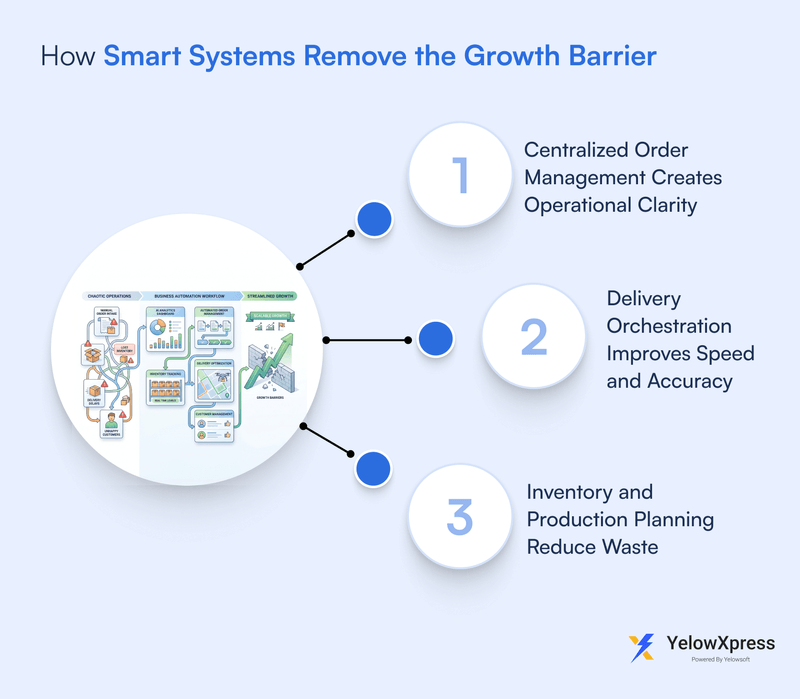
Restaurants scale faster when operations become system-driven instead of people-dependent. Know about the changes you can make to remove these barriers.
Centralized Order Management Creates Operational Clarity
A restaurant cannot scale if every order requires manual attention.
The right online food delivery software brings all orders into one dashboard where teams can manage preparation, dispatch, updates, and delivery progress from one place.
This reduces duplicate work and improves coordination between kitchen staff, dispatchers, and delivery riders.
It also helps managers understand where delays happen and which channels perform best.
A strong food ordering platform does not just collect orders. It helps restaurants process them efficiently and gives operators better control over daily performance.
Delivery Orchestration Improves Speed and Accuracy
Delivery is where many restaurants lose control.
The food is ready, but the driver is late. The route is inefficient. The customer receives no updates.
Delivery orchestration solves this by connecting auto dispatch, route optimization, batching, delivery tracking, and live customer notifications into one smooth workflow.
This reduces delays and improves delivery confidence for both staff and customers.
Platforms like YelowXpress help restaurants manage this process more effectively by reducing manual follow-ups and improving delivery flow. For restaurants crossing 50 daily orders, delivery orchestration is no longer optional. It becomes necessary for survival.
Inventory and Production Planning Reduce Waste
Scaling is not only about faster delivery.
It is also about protecting profit margins.
Inventory planning, demand forecasting, and menu performance tracking help restaurants prepare smarter.
Without these systems, overstocking and stockouts become common. Waste increases, margins shrink, and profitability becomes harder to maintain.
Smart systems connect order trends with production planning, helping restaurants improve preparation accuracy and reduce unnecessary waste.
Cloud kitchen scaling guides consistently recommend this as a core part of profitable restaurant growth.
Why Analytics Matter More Than More Staff
Growth becomes predictable when decisions are based on data instead of assumptions.
Real-Time Reporting Helps You Fix Problems Faster
Many restaurants look at reports after the damage is already done.
That is too late.
Real-time reporting helps operators solve problems while they are still active.
Analytics help track delayed orders, delivery success rates, repeat customer behavior, kitchen performance, and rider productivity. These insights help restaurant owners make immediate improvements instead of relying on assumptions.
If delivery delays happen mostly during specific hours, staffing can be adjusted. If one menu item creates repeated delays, kitchen workflow can be improved.
Data turns assumptions into action.
Standardization Makes Expansion Safer
Opening a second outlet or cloud kitchen sounds like growth.
But if the first location already depends on manual fixes, expansion only multiplies the same problems.
Restaurants need standardized systems for order intake, preparation, packing, dispatch, payments, inventory, and reporting.
Without consistency, every location performs differently and quality becomes difficult to control.
A structured online food ordering platform helps restaurants maintain operational consistency across multiple outlets. That is what makes scaling safer and more predictable.
Expert Tip:
Before opening another outlet, document your top ten repeatable workflows and move them into your operating system first. Expansion should multiply systems, not problems.
Quick Wins Restaurants Can Implement Today
Scaling does not require rebuilding everything at once. It starts with fixing the biggest friction points first. Know below
Start With Order Management and Delivery Visibility
The fastest improvement usually comes from controlling order flow.
Start by centralizing order management, improving dispatch visibility, and strengthening customer communication.
When your team can clearly see every order and its delivery status, daily pressure drops immediately.
A strong restaurant delivery management software setup improves control across the full customer journey and creates faster operational improvements without requiring major structural changes.
Build Retention Before Chasing More Acquisition
Many restaurants spend heavily on acquiring new customers while losing existing ones because of poor delivery experiences.
That is expensive growth.
Retention should be part of your delivery strategy.
Customers return when ordering is simple, food arrives on time, updates are clear, and service feels reliable.
Loyalty systems, repeat order flows, and better customer communication improve long-term profitability far more than constant discounting.
This is where a strong food ordering platform creates real business value. Retention-first growth is always more profitable than acquisition-first growth.
Conclusion
Restaurants rarely fail because people stop wanting their food.
They fail because operations cannot support delivery consistency as demand grows.
After 50 daily orders, small inefficiencies become expensive problems. Delays increase. Food costs rise. Customer trust drops. Repeat business becomes harder to protect.
This is where strong systems matter most.
The right online food delivery software helps restaurants control orders, improve delivery speed, reduce waste, and create predictable growth without depending on manual coordination.
If your restaurant is already facing delivery pressure, the goal should not be getting more orders.
The goal should be building the operational foundation to handle those orders profitably.
That is where platforms like YelowXpress help restaurants move from daily survival to sustainable scale.
Turn Orders Into Profitable Growth
The biggest reason is weak operational systems. Kitchens, dispatch, and delivery processes cannot handle higher order volume consistently and profitably.
It centralizes orders, improves dispatch, reduces delivery delays, tracks performance, and helps restaurants manage growth without depending on manual processes.
Late deliveries damage trust. When food arrives cold or updates are unclear, customers often stop ordering instead of filing complaints.
Restaurants should invest when order volume creates delays, delivery confusion, inventory issues, or customer complaints that manual operations cannot handle efficiently.