Many grocery businesses assume delivery problems begin with drivers.
They think delays happen because drivers are late, routes are longer, or dispatch teams are overloaded. But in reality, most delivery failures start much earlier, during order scheduling.
When customers are given unclear delivery promises like “delivery by evening” or “arriving sometime today,” operations become unpredictable.
-
Drivers reach closed doors.
-
Customers call support teams repeatedly.
-
Refund requests increase.
-
Repeat customers lose trust.
This creates a hidden operational problem that grows faster as your order volume increases.
That is where time slot delivery becomes critical.
Instead of treating delivery as a last-minute task, it creates structure before dispatch even begins. Customers choose a preferred delivery window, your team manages delivery capacity in advance, and operations become easier to control.
This blog explains why time slot delivery has become essential for modern grocery businesses and how the right grocery delivery software helps you scale without delivery chaos.
What Is Time Slot Delivery in Grocery Operations?
Before solving delivery failures, you need to understand where delivery control actually begins.
Understanding Scheduled Delivery Windows
Time slot delivery allows customers to select a preferred delivery window while placing an order.
Instead of uncertain delivery promises, the customer chooses a specific delivery period such as:
-
8 AM to 10 AM
-
10 AM to 12 PM
-
Same-day priority delivery
-
Scheduled next-day delivery
This creates better predictability for both the customer and your operations team.
Your store can manage delivery capacity based on available slots instead of accepting unlimited orders without planning. Dispatch teams know which deliveries must go first. Drivers can be assigned more efficiently.
This improves delivery planning, route efficiency, customer availability, and order fulfillment accuracy
Without structured delivery windows, dispatch becomes reactive. With delivery slot management, it becomes planned.
Why Grocery Delivery Is Different from Food Delivery
Many businesses compare grocery delivery with restaurant delivery, but both work very differently.
Food delivery is usually immediate, low basket value, single meal focused, and short delivery expectation
Whereas, grocery delivery often involves larger baskets, family purchases, repeat household orders, perishables, bulk deliveries, and scheduled weekly orders
Customers are planning groceries around their daily routine. They expect reliability, not only speed.
If a pizza arrives 20 minutes late, it creates inconvenience. If a weekly grocery order arrives late, it affects an entire household.
That is why grocery delivery management software needs stronger scheduling control than standard food delivery systems.
Why Grocery Deliveries Start Failing Without Time Slot Management
Most delivery problems are not random. They are created by poor scheduling systems. Here’s why grocery deliveries start failing without time slot management:
Delivery Delays Create Customer Frustration
When delivery windows are unclear, customers do not know when to expect their order. This creates delayed fulfillment, late dispatch, missed handovers, and customer absence during delivery
Customers start calling your support team asking:
“Where is my order?”
That single question creates operational pressure across your business. The problem is not delivery speed alone. It is delivery uncertainty.
Trust drops quickly when customers cannot predict delivery timing.
Failed Deliveries Increase Refund and Reattempt Costs
A failed delivery creates more than one problem.
It creates redelivery expenses, wasted driver hours, additional fuel costs, refund requests, and operational delays for other deliveries This affects margins directly.
Every failed delivery increases cost without increasing revenue. And when repeated often, it damages profitability.
For businesses handling perishables like dairy, vegetables, frozen goods, or medicines, failed delivery becomes even more expensive.
Manual Scheduling Breaks at Scale
Manual scheduling may work at low volume. It stops working when your business crosses 50 to 100+ daily orders.
Common problems include:
-
WhatsApp coordination
-
Spreadsheet dispatching
-
Manual driver assignment
-
Dependency on specific staff members
This creates bottlenecks.
Growth should increase revenue, not operational stress. Without time slot delivery software, more orders often mean more problems.
Expert Tip:
If your team still confirms delivery windows manually through calls or WhatsApp, your delivery system is already creating hidden cost leakage. Operational scale requires automated slot control, not manual coordination.
How Time Slot Delivery Improves Grocery Operations
The real value of delivery slots is operational control. Here’s how time slot delivery improves grocery operations:
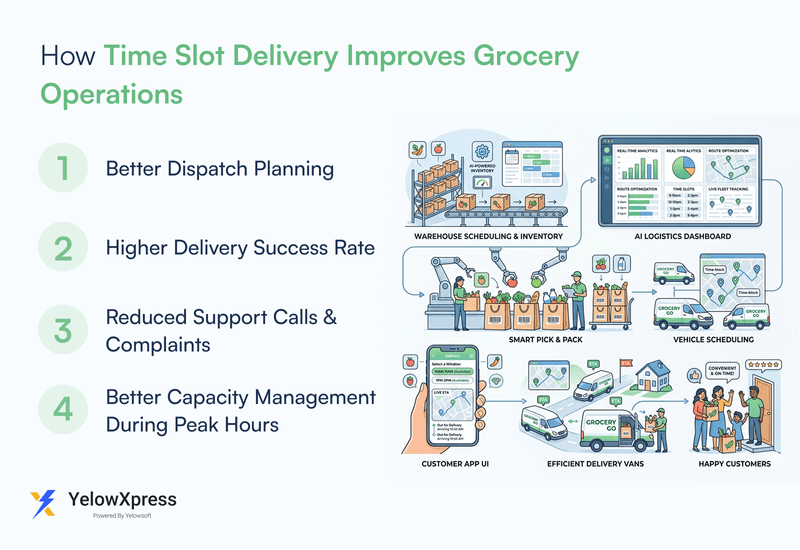
Better Dispatch Planning
Drivers should not be assigned randomly. With time slot delivery, dispatch teams can assign drivers based on customer location, route efficiency, delivery clusters, and delivery priority
This improves driver productivity because routes become structured instead of reactive.
It also reduces idle time and unnecessary travel distance. Smarter dispatch means better margins.
Higher Delivery Success Rate
Customers are more likely to be available when they select the delivery slot themselves. This improves first-attempt delivery success, on-time fulfillment, and customer satisfaction
Less failed delivery means fewer refunds and fewer reattempts. It also builds trust because customers feel delivery promises are reliable.
In grocery operations, repeat trust matters more than one-time speed.
Reduced Support Calls and Complaints
When customers know when delivery is coming, where the driver is, what to expect, they stop calling support teams repeatedly.
This reduces customer service pressure and allows staff to focus on operations instead of solving preventable issues. Live tracking and delivery notifications strengthen this even further.
Better Capacity Management During Peak Hours
Peak delivery periods create the highest operational risk.
Examples include:
-
Weekends
-
Festive seasons
-
Month-end stock-up periods
-
Promotional campaigns
Without slot management, these periods create delivery overload. And with delivery slot management, you control intake before dispatch problems begin. This protects both customer experience and operational stability.
Here’s a quick comparison of manual delivery scheduling vs time slot delivery software:
This comparison shows why structured delivery systems outperform manual processes.
| Manual Scheduling | Time Slot Delivery Software |
|---|---|
| Phone and WhatsApp coordination | Automated slot booking |
| No delivery planning visibility | Real-time capacity control |
| Frequent failed deliveries | Higher successful deliveries |
| Driver confusion | Optimized dispatch |
| More support calls | Fewer customer complaints |
| Revenue leakage | Better operational margins |
The goal is not just automation. The goal is profitable predictability.
Key Features to Look for in Grocery Delivery Time Slot Management
Not every delivery system solves grocery-specific problems. Here are the key features to look for in a grocery delivery time slot management system:
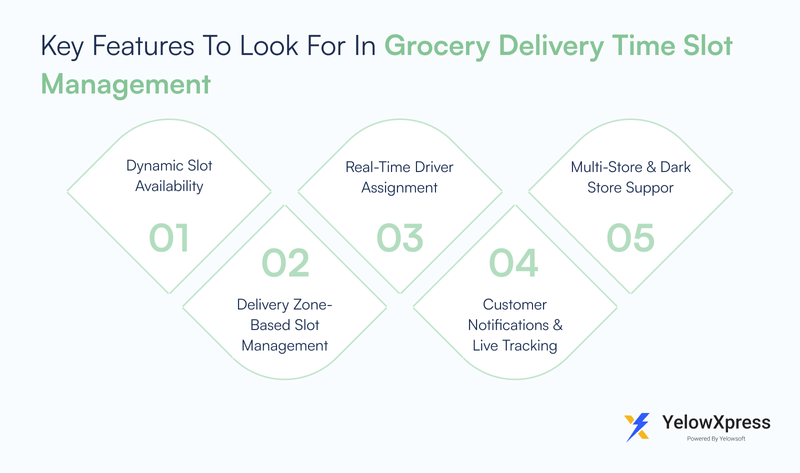
Dynamic Slot Availability
Slots should not remain fixed all day. They should open or close based on delivery capacity, active order volume,driver availability This prevents overbooking and protects service quality.
Static slot systems create operational blind spots. And dynamic systems create delivery balance.
Delivery Zone-Based Slot Management
Different zones need different delivery logic.
For example:
-
Urban areas may support express delivery
-
Suburban zones may require scheduled delivery
Your online grocery delivery software should support zone-based slot rules instead of one universal system. This improves efficiency and reduces unrealistic delivery promises.
Real-Time Driver Assignment
Time slots and dispatch should work together. They should not operate separately.
Once an order enters a delivery slot, the system should support smart driver assignment based on availability and route planning. This removes manual dependency.
Customer Notifications and Live Tracking
Customer notifications is essential for customer trust, transparency, and repeat orders
Customers want confidence, not uncertainty. And notifications and tracking reduce anxiety and improve retention.
Multi-Store and Dark Store Support
For chains, franchises, and quick commerce models, one-store logic is not enough.
The system must support multiple outlets, dark stores, centralized visibility, and distributed fulfillment This is critical for serious operational growth.
Expert Tip:
If your delivery software handles ordering and dispatch separately, scale becomes difficult.
The strongest systems connect slot booking, dispatch, tracking, and reporting inside one operational flow. That is where long-term efficiency comes from.
How Time Slot Delivery Helps Grocery Businesses Scale Beyond 100 Orders a Day
Growth creates complexity. Without structure: more orders = more delivery problems
With time slot delivery: more orders = controlled growth
This improves repeat customer confidence, SLA reliability, operational predictability, and delivery margin protection. Customers trust businesses that deliver consistently. Not occasionally.
When your delivery process becomes predictable, customers order again without hesitation. That is how scale becomes profitable.
Not through more drivers alone. Through better systems.
Why Grocery Businesses Need Their Own Delivery System Instead of Aggregator Dependency
Third-party delivery apps help with reach, but they rarely prioritize your operations.
They do not optimize for your delivery slot logic, customer retention, delivery efficiency, and margin protection
Their goal is marketplace volume. Your goal is operational profitability.
Owning your own grocery delivery software gives you:
-
Full delivery control
-
Customer ownership
-
Repeat order visibility
-
Slot management flexibility
-
Long-term business stability
This is where sustainable profitability happens.
Aggregator dependency creates temporary growth. Whereas, operational ownership creates long-term business value.
Final Thoughts
Fast delivery may attract the first order, but predictable delivery is what brings customers back. In grocery operations, customers care less about promises of “quick delivery” and more about knowing exactly when their order will arrive. That trust shapes repeat purchases, stronger retention, and better long-term revenue.
Time slot delivery helps you create that trust. It reduces failed deliveries, improves dispatch planning, controls peak-hour pressure, and protects your delivery margins. As your business grows, these small operational improvements become major revenue drivers.
If you want to scale beyond daily delivery chaos, your business needs more than drivers. It needs structure. This is where YelowXpress grocery delivery software helps. From slot management to dispatch control and live tracking, it gives you the operational clarity needed to grow with confidence and keep customers coming back.
Want to Reduce Failed Deliveries and Improve Grocery Order Fulfillment?
Time slot delivery allows customers to choose a specific delivery window while placing an order. This helps grocery businesses plan dispatch better, improve delivery success rates, and reduce failed deliveries.
Customers are more likely to be available during their selected delivery slot. This reduces missed handovers, redelivery costs, refund requests, and wasted driver hours.
Grocery deliveries often involve larger orders, perishables, and repeat household purchases. Proper scheduling improves reliability, protects margins, and helps businesses maintain customer trust.
It should include dynamic slot availability, delivery zone management, real-time driver assignment, customer notifications, live tracking, and multi-store support for scalable operations.
They scale by replacing manual scheduling with structured delivery slot management, automated dispatch planning, and full operational visibility through the right grocery delivery software.