Running a successful restaurant today is about far more than serving great food.
A customer can love your menu, appreciate your pricing, and enjoy your brand. Yet one delayed delivery can completely change how they view your business.
Picture this. A customer orders lunch expecting it within 30 minutes. Forty five minutes later, the order finally arrives. The food still tastes good, but frustration has already set in. Instead of recommending your restaurant, the customer leaves a three star review and decides to try another option next time.
This situation is becoming increasingly common as customer expectations continue to rise. The global online food delivery market is expected to exceed $1.4 trillion by 2029. As more customers rely on delivery, speed and reliability have become just as important as food quality.
Research shows that nearly 80% of customers consider the delivery experience as important as the food itself.
At the same time, 93% of consumers read online reviews before making a purchase decision and 84% are unlikely to return after a poor delivery experience.
For restaurants, delivery delays are no longer minor operational issues. They directly affect ratings, customer retention, and long term revenue.
Let's explore why late deliveries damage restaurant ratings and how the right online food ordering software can help you prevent them.
Why Delivery Experience Has Become a Major Ranking Factor for Restaurants
Before understanding the impact of delivery delays, it helps to understand how customer behavior has changed.
Customers Judge the Entire Experience, Not Just the Food
A few years ago, customers primarily evaluated restaurants based on food quality and dining experience. Today, a growing percentage of restaurant interactions happen through delivery.
For delivery customers, the experience includes:
-
Ordering convenience
-
Checkout process
-
Delivery updates
-
Delivery speed
-
Food condition upon arrival
In other words, delivery has become part of the product.
Customers no longer separate food quality from delivery quality. If the food arrives late, cold or without updates, the entire experience feels disappointing.
This is why two restaurants with similar food quality can receive very different ratings. The restaurant that consistently delivers on time often earns stronger customer loyalty.
Online Reviews Amplify Every Delivery Mistake
Customers are far more likely to talk about bad experiences than ordinary ones.
When delivery goes smoothly, customers often consider it expected. When delivery goes wrong, they feel compelled to share their frustration.
That frustration frequently appears in:
-
Google Reviews
-
Restaurant review platforms
-
Food delivery marketplaces
-
Social media posts
Studies suggest that 72% of customers share negative experiences with others.
A single delayed order can therefore influence many future customers who read those reviews before placing an order.
How Late Deliveries Directly Impact Restaurant Ratings
A delayed delivery rarely ends with one unhappy customer. It often creates a ripple effect that impacts future business.
Customers Associate Delays With Poor Service
Customers do not usually differentiate between kitchen delays, dispatch issues or driver shortages.
They simply see the restaurant as responsible for the entire experience.
When delivery arrives late, customers often conclude:
-
The restaurant is disorganised
-
Service quality is poor
-
Future orders may be unreliable
Even when the food itself meets expectations, delivery delays create doubts about professionalism and consistency.
One Bad Experience Can Lead to Negative Reviews
Waiting creates emotional frustration.
Customers become increasingly irritated when they receive no updates or when promised delivery times pass without explanation.
That emotional response often translates directly into reviews.
A customer who would have left a five star review may instead leave three stars because of a delayed delivery.
Unfortunately, online reviews remain visible long after the problem has been resolved.
Delays Reduce Repeat Orders
Acquiring new customers is expensive.
Keeping existing customers is far more profitable.
Yet repeated delivery issues push customers toward competitors.
Research shows that 73% of customers are willing to switch brands after multiple poor experiences.
This means delivery delays do not simply affect today's revenue. They reduce the likelihood of future orders and weaken customer loyalty over time.
Expert Tip:
Track repeat order rates based on delivery performance. Many restaurants discover that customers receiving orders within promised delivery windows reorder significantly more often than customers experiencing delays.
The Hidden Business Cost of Delivery Delays
Poor delivery performance affects far more than customer satisfaction.
It impacts business growth in measurable ways.
Lower Ratings Reduce New Customer Acquisition
Online reviews influence purchasing decisions more than many restaurant owners realise.
Since 93% of consumers read reviews before buying, ratings often act as trust signals.
Consider two restaurants offering similar cuisine.
One has a 4.8-star rating. The other has a 3.9-star rating. Most customers will naturally choose the higher-rated option.
Even a small decline in ratings can reduce conversion rates and order volume.
Small Rating Drops Can Create Large Revenue Losses
Studies show that improving ratings by just one star can increase revenue by 5% to 9%.
The reverse is also true.
A decline in ratings can reduce customer confidence, lower order frequency and weaken overall profitability.
This makes delivery performance a revenue issue, not simply a logistics issue.
Increased Customer Support Burden
Late deliveries generate additional operational costs.
Staff spend more time handling delivery complaints, refund requests, compensation offers, customer follow-ups.
Instead of focusing on growth and customer experience, teams become occupied with damage control.
What Causes Late Deliveries in Restaurant Operations?
Many restaurants assume drivers are solely responsible for delivery delays.
In reality, delays often begin much earlier.
Manual Order Processing Creates Bottlenecks
Restaurants relying on multiple tablets, phone orders or manual workflows often experience unnecessary delays.
Common issues include missed orders, incorrect order entry, delayed kitchen communication, longer preparation times.
A centralised restaurant order management system helps reduce these bottlenecks by streamlining order flow.
Poor Driver Allocation and Dispatching
Assigning the wrong driver or failing to match delivery demand with driver availability creates avoidable delays.
Common problems include driver shortages during peak hours, inefficient delivery routes, delayed pickup assignments.
These issues quickly increase delivery times and customer dissatisfaction.
Lack of Real Time Delivery Visibility
Many restaurants operate reactively.
They discover delays only after customers begin calling.
Without visibility into delivery progress, teams cannot proactively resolve issues.
This is especially important because 90% of consumers now expect real time delivery visibility.
Order Volume Surges During Peak Hours
Lunch periods, dinner rushes, weekends and special promotions can quickly overwhelm operations.
Without scalable systems, order volume often grows faster than operational capacity.
The result is delayed preparation, delayed dispatching and ultimately delayed delivery.
Expert Tip:
Review order volume patterns by 30-minute intervals rather than hourly averages. This often reveals hidden operational bottlenecks that traditional reporting misses.
Warning Signs That Delivery Delays Are Damaging Your Reputation
The impact of delivery delays usually appears before revenue declines become obvious.
Rising Complaints About Delivery Times
Watch for recurring mentions such as slow delivery, late arrival, poor communication, missed delivery estimates.
When these comments appear repeatedly, operational problems likely exist.
Increasing Refund and Compensation Requests
Customers requesting credits, discounts, or refunds often indicate growing dissatisfaction.
These costs add up quickly and can significantly affect margins.
Declining Repeat Order Rates
One of the clearest indicators of delivery problems is falling customer retention.
Customers may stop complaining entirely and simply stop ordering.
That silent churn is often more damaging than negative reviews.
How Online Food Ordering Software Helps Prevent Delivery Delays
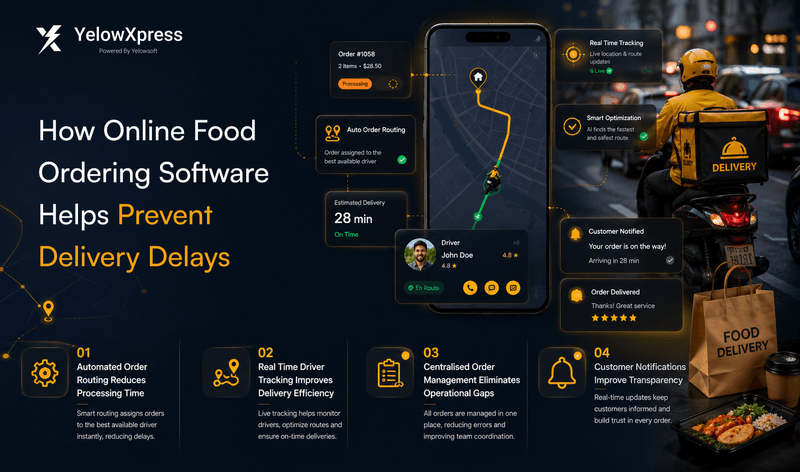
Hiring more drivers is not always the solution.
The most effective improvements usually come from better operational visibility and automation.
Automated Order Routing Reduces Processing Time
Modern online food ordering software automatically routes orders to the appropriate teams.
Benefits include:
-
Faster order acceptance
-
Reduced manual work
-
Improved kitchen efficiency
-
Lower risk of missed orders
Every minute saved at the beginning of the process improves final delivery performance.
Real Time Driver Tracking Improves Delivery Efficiency
Driver tracking provides visibility into delivery progress.
Restaurants can:
-
Monitor delivery status
-
Identify delays early
-
Adjust dispatching decisions
-
Improve customer communication
This proactive approach helps prevent minor delays from becoming major customer complaints.
Centralised Order Management Eliminates Operational Gaps
A modern online food delivery software solution creates a single source of truth for operations.
Teams can manage:
-
Incoming orders
-
Kitchen workflows
-
Delivery status
-
Customer updates
from one centralised platform.
Customer Notifications Improve Transparency
Customers are more patient when they know what is happening.
Automated notifications can update customers when:
-
Orders are accepted
-
Food preparation begins
-
Drivers are assigned
-
Deliveries are approaching
Clear communication reduces uncertainty and improves customer confidence.
Best Practices to Improve Delivery Performance and Ratings
Technology provides the foundation, but operational discipline remains essential.
Set Realistic Delivery Expectations
Overpromising delivery times creates disappointment.
Providing accurate delivery estimates builds trust and improves satisfaction.
Monitor Delivery Metrics Consistently
Key metrics include:
-
Average delivery time
-
On-time delivery percentage
-
Customer ratings
-
Driver utilization rates
These indicators help identify problems before customers notice them.
Optimize Staffing During Peak Hours
Historical order data can help predict demand spikes.
Proper scheduling ensures both kitchen teams and drivers can handle peak periods efficiently.
Use an Integrated Online Food Delivery Platform
An integrated online food delivery platform connects ordering, preparation, dispatching and delivery into a single workflow.
This creates:
-
Better visibility
-
Faster execution
-
Improved customer experiences
Expert Tip:
Measure "time to dispatch" separately from total delivery time. Many restaurants focus only on final delivery speed while ignoring the delays that occur before a driver is even assigned.
How Modern Restaurants Use Technology to Protect Their Ratings
Leading restaurants increasingly view delivery operations as part of reputation management.
They invest in systems that improve visibility, communication, and execution.
| Traditional Process | Modern Delivery Workflow |
|---|---|
| Manual order entry | Automated order flow |
| Limited driver visibility | Real time tracking |
| Customer uncertainty | Live delivery updates |
| Reactive issue handling | Proactive delay management |
| Inconsistent delivery times | Optimized delivery operations |
Modern restaurants often combine:
-
Online food ordering platform capabilities
-
Real time tracking
-
Automated dispatching
-
Performance analytics
-
Customer communication tools
This creates a more reliable experience that protects ratings and encourages repeat business.
Solutions such as on-demand restaurant delivery software and on-demand restaurant ordering software help restaurants scale operations without sacrificing customer satisfaction.
Conclusion
Late deliveries affect much more than customer convenience. They influence reviews, ratings, repeat orders, customer trust, and ultimately revenue.
As delivery continues to become a larger part of restaurant operations, customers increasingly judge businesses based on reliability as much as food quality. A single delayed order may seem insignificant, but repeated delays can gradually damage a restaurant's reputation and make growth harder to sustain.
The good news is that most delivery problems are preventable. Better visibility, automated workflows, improved dispatching, and proactive communication can significantly improve delivery performance and customer satisfaction.
Restaurants that consistently earn strong ratings are not necessarily those with the best food. They are often the ones that deliver consistently, communicate clearly, and create predictable customer experiences.
If you want to reduce delivery delays, improve customer retention, and protect your online reputation, investing in the right online food ordering software can help create a faster, more connected, and more reliable delivery operation.
Improve Delivery Performance Before Ratings Drop
Late deliveries create frustration and reduce customer satisfaction. Customers often associate delivery delays with poor service, resulting in lower ratings and negative reviews.
Customers who experience repeated delivery delays are more likely to switch to competitors, reducing customer retention, loyalty, and long term restaurant revenue.
Common causes include manual order processing, poor driver allocation, lack of delivery visibility, and operational bottlenecks during peak ordering periods.
Online food ordering software automates order management, improves dispatch efficiency, enables real time tracking, and helps restaurants deliver orders more consistently.
Real time tracking improves transparency, reduces customer uncertainty, enables proactive issue resolution, and helps restaurants maintain higher customer satisfaction ratings.