Out of stock issues look small from the outside. One missing item. One refund. One replacement request. But for grocery businesses, they create a much larger problem.
A customer does not judge your online grocery experience only by delivery speed. They judge it by whether the products they ordered actually arrive. If milk, bread, vegetables, baby products, medicines, or household essentials are missing, the order feels incomplete. The customer may accept it once. If it happens again, trust starts to disappear.
That is why grocery delivery software has become so important for grocery retailers, local stores, dark stores, and quick commerce businesses in the US and UK. It helps businesses manage stock visibility, prevent overselling, suggest substitutions, measure lost sales, and improve fulfillment accuracy.
Industry studies show that perpetual inventory accuracy in some retail systems has been measured as low as 32 to 45 percent. That directly increases the risk of out of stock orders. The same research also shows that improving inventory accuracy and merchandising discipline can reduce out of stock levels by roughly 40 percent.
This blog explains how a modern grocery delivery system handles out of stock issues before they damage customer retention, delivery performance, and revenue.
Why Out of Stock Issues Still Happen in Grocery Delivery
Out of stock problems rarely start at the customer checkout. They usually begin much earlier, inside inventory systems, store processes, supplier coordination, or shelf execution. When those areas are weak, the online store shows products that are not truly available.
That is where the customer experience breaks.
Inventory Data Does Not Match Shelf Reality
A grocery item may appear available in the system, but it may not be available for picking. It may be misplaced, damaged, expired, wrongly received, or still sitting in the backroom.
This creates a gap between system inventory and actual sellable stock.
For online grocery, that gap is costly. Customers trust the product availability shown on your app or website. If the item disappears after checkout, the customer feels misled.
A strong grocery ordering system reduces this gap by syncing inventory data more frequently across POS, warehouse systems, storefronts, and fulfillment teams. When inventory updates happen in real time, your online catalog becomes more reliable.
Lost Sales Are Not Always Measured Properly
Many grocery businesses track completed orders. Fewer track the sales they lost because a product was unavailable.
That is a serious blind spot.
If a customer removes an unavailable item from the cart, rejects a substitution, or cancels the full order, the business loses revenue. But if the system does not capture that loss clearly, the issue stays hidden.
This is why POS based lost sales measurement matters. It helps your team understand which SKUs are repeatedly causing revenue leakage and which stores are failing to fulfill demand.
Shelf Execution Can Create False Stockouts
Sometimes the product exists, but the picker cannot find it.
This happens because of poor shelf replenishment, weak planogram execution, incorrect product placement, or delayed backroom movement. In grocery delivery, this becomes a fulfillment problem.
Customers do not care whether the issue happened in the warehouse, on the shelf, or inside the system. They only know that the product they ordered did not arrive.
A modern grocery delivery software setup helps connect item availability, store processes, and fulfillment visibility so these failures are easier to detect.
High Velocity Products Create Repeated Pressure
Not every product creates the same risk.
High velocity SKUs like milk, bread, eggs, bananas, water, baby products, fresh produce, and household staples usually create the most pressure. Food logistics experts recommend focusing on high velocity SKUs and problematic stores because a small number of products and locations often create a large share of out of stock incidents.
This is why analytics matters. It helps your team stop treating every SKU equally and start focusing on the items that affect revenue and customer trust the most.
Expert Tip:
Build an out of stock heatmap by SKU velocity, store location, substitution rejection rate, and lost revenue. This gives operations teams a sharper view than basic inventory reports because it shows where stockouts are hurting profit, not just where they are happening.
How Grocery Delivery Software Improves Real Time Inventory Control
The first job of grocery delivery software is to make product availability more accurate. Without this foundation, every other process becomes reactive.
When inventory accuracy improves, order fulfillment becomes easier, customer support load drops, and delivery teams waste less time handling incomplete orders.
Storefront and POS Inventory Sync
A grocery storefront should not operate separately from the POS or inventory system.
If an item sells in store, your online catalog should update quickly. If stock is added, removed, damaged, or reserved, that change should reflect across the ordering platform.
This is where real time SKU availability becomes valuable.
A connected grocery delivery system syncs item level data across the customer app, website, store system, picker dashboard, and fulfillment team. This reduces overselling and prevents customers from ordering products that are no longer available.
Low Stock Alerts Before Checkout
Out of stock handling should not begin after payment.
A better approach is to warn customers before they complete the order. If only a few units are left, the system can show limited availability, restrict quantity, or recommend alternatives.
This improves customer expectations before the order reaches fulfillment.
For grocery operators, this reduces last minute order edits and support calls. For customers, it creates a more honest buying experience.
Inventory Reservation During Checkout
One common issue in online grocery is double selling.
Two customers may add the same low stock item to their carts at the same time. Without proper inventory reservation, both orders may go through, but only one can be fulfilled.
A smart grocery ordering system can temporarily reserve stock during checkout. Once payment is completed, the reservation becomes confirmed. If the customer abandons the cart, the item returns to available inventory.
This is especially useful for fast moving grocery items during peak hours.
Item Level Visibility for Pickers
Out of stock handling also depends on the picking experience.
If pickers cannot see accurate product location, available quantity, substitution rules, and packing priority, errors increase. A good system gives pickers clear item level information inside the fulfillment workflow.
This helps them act faster when a product is missing, damaged, or unavailable.
Instead of calling the manager or manually checking with another team, they can follow predefined substitution and escalation rules.
How Predictive Replenishment Reduces Future Stockouts
Real time inventory helps you handle today’s availability. Predictive replenishment helps you prepare for tomorrow’s demand.
This is where on demand grocery delivery software becomes more strategic. It does not only record what happened. It helps forecast what is likely to happen next.
Forecasting Based on Sales Velocity
Sales velocity shows how quickly a product moves.
If a SKU sells faster than usual, the system can flag it before stock runs out. This is especially useful for fresh produce, dairy, bakery items, meat, frozen goods, and household essentials.
Forecasting engines use historical sales, order frequency, seasonal patterns, and recent demand changes to recommend replenishment timing.
This helps your business avoid stockouts before they reach the customer.
Demand Planning for Peak Hours
Grocery demand is not equal throughout the day.
Evening orders, weekend demand, payday spikes, weather related buying, and holiday periods can create sudden pressure. If your replenishment process does not account for those patterns, out of stock issues rise quickly.
A modern grocery delivery software platform helps identify these demand windows and prepare inventory earlier.
This is very important for US and UK grocery businesses where customers expect fast availability, clear delivery slots, and reliable fulfillment.
Better Planning for Perishable Products
Perishables create a difficult balance.
Overstocking creates waste. Understocking creates missed orders.
That is why grocery operators need demand forecasting that considers expiry windows, average daily sales, delivery slot demand, and supplier lead time.
A good grocery delivery system helps teams order the right quantity at the right time. This protects margins while reducing unavailable items.
Store Specific Replenishment Rules
Different stores do not always behave the same way.
A product that sells quickly in one area may move slowly in another. That means replenishment should not be based only on central averages.
Store specific forecasting helps localize stock planning. It gives each outlet, dark store, or fulfillment center a better replenishment model based on its own demand pattern.
Expert Tip:
Set replenishment triggers using dynamic reorder points instead of fixed minimum stock levels. A dynamic reorder point should include sales velocity, supplier lead time, safety stock, expiry risk, and upcoming delivery slot load.
How Smart Substitutions Save Orders
Even with strong inventory control, some products will still become unavailable. The goal is to recover the order without disappointing the customer.
This is where substitution logic becomes one of the most important parts of grocery delivery software.
Relevant Alternatives at Checkout
If an item is unavailable, the system should not simply say “out of stock.”
It should offer a useful alternative.
For example, if a customer selects a 1 litre milk pack and it is unavailable, the system can suggest another brand, a larger pack size, or a similar product within the same category.
This keeps the customer inside the buying journey.
It also reduces cart abandonment because the customer can make a decision before payment.
Customer Approved Substitution Rules
Not every customer wants substitutions.
Some may prefer replacement only from the same brand. Some may accept any similar product. Others may want a refund if the original item is unavailable.
A smart grocery ordering system lets customers define substitution preferences during checkout.
This improves transparency and reduces post order complaints.
For grocery businesses, it also makes fulfillment faster because pickers do not need to guess what the customer will accept.
Margin Aware Substitution Logic
Substitutions should not only match product category.
They should also consider price, margin, brand preference, pack size, dietary restrictions, and previous customer behavior.
For example, suggesting a cheaper product may protect the order but reduce revenue. Suggesting an expensive substitute may increase rejection. The best system balances customer acceptance and business profitability.
This is where operational intelligence becomes more valuable than basic product matching.
Split Fulfillment from Nearby Stores
If one store does not have the item, another location may have it.
A stronger on demand grocery delivery software setup can route fulfillment from a nearby outlet, dark store, or micro fulfillment center. This helps businesses preserve the order even when one location fails.
For multi outlet grocery brands, this is a major advantage.
Instead of cancelling the item, the system searches for the best available fulfillment option.
Expert Tip:
Create substitution scoring rules that rank alternatives by product similarity, margin impact, stock freshness, customer history, and fulfillment distance. This creates better substitution decisions than simple category based replacement.
How Analytics Helps Teams Prioritize the Right Stockout Problems
A business cannot fix every stockout equally.
Some stockouts barely affect revenue. Others damage high value customer relationships, repeat orders, and basket size.
This is why analytics is essential.
SKU Level Out of Stock Reports
SKU level reporting helps identify which products fail most often.
Instead of looking only at broad availability percentages, your team can see exactly which products create the highest number of missed orders.
This supports faster corrective action.
For example, if strawberries are repeatedly unavailable every weekend, the issue may be poor demand planning. If a specific milk brand is always missing at one store, the issue may be supplier coordination or shelf replenishment.
Store Level Performance Tracking
Some locations perform better than others.
A grocery delivery system should show which stores have the highest out of stock rates, highest substitution rejection, and most lost sales.
This helps managers compare outlet performance and identify operational gaps.
The goal is not to blame stores. The goal is to make improvement visible.
Lost Revenue Measurement
Out of stock rate alone does not tell the full story.
A low value SKU may be unavailable often but create little financial damage. A high value or high frequency SKU may create major revenue loss even with fewer incidents.
That is why lost revenue tracking is important.
It helps the business focus on stockouts that matter most commercially.
Substitution Acceptance Rate
Substitution acceptance rate tells you how well your recovery process works.
If customers reject most substitutions, your alternatives may be poor. If they accept them often, your system is protecting revenue and trust.
This is one of the most useful metrics for online grocery operations.
Why Supplier Collaboration Matters in Out of Stock Control
Out of stock issues are not only internal problems.
Suppliers, distributors, stores, and fulfillment teams all affect availability.
A strong grocery delivery software setup helps improve collaboration across this chain.
Shared Demand Data with Suppliers
When suppliers only receive basic purchase orders, they cannot see real customer demand.
But when they can access item level demand patterns, recurring stock gaps, and location based sales trends, planning improves.
Industry sources repeatedly identify vendor and retailer collaboration as a core enabler for reducing out of stock issues.
Shared data helps suppliers understand what is needed, where it is needed, and when it is needed.
Better Purchase Planning
Purchase planning becomes stronger when the system connects inventory levels with demand forecasts.
Instead of ordering based on guesswork, teams can plan replenishment around real sales velocity, stock movement, and delivery demand.
This reduces both stockouts and overstocking.
For grocery businesses, this balance is important because margins are often tight and waste can quickly damage profitability.
Supplier Performance Monitoring
Not all suppliers perform equally.
A good system can help track late deliveries, partial deliveries, fill rates, damaged goods, and recurring SKU gaps.
This gives procurement teams a clearer view of supplier reliability.
Over time, it supports better negotiations, better vendor selection, and stronger availability planning.
How YelowXpress Helps Grocery Businesses Handle Out of Stock Issues
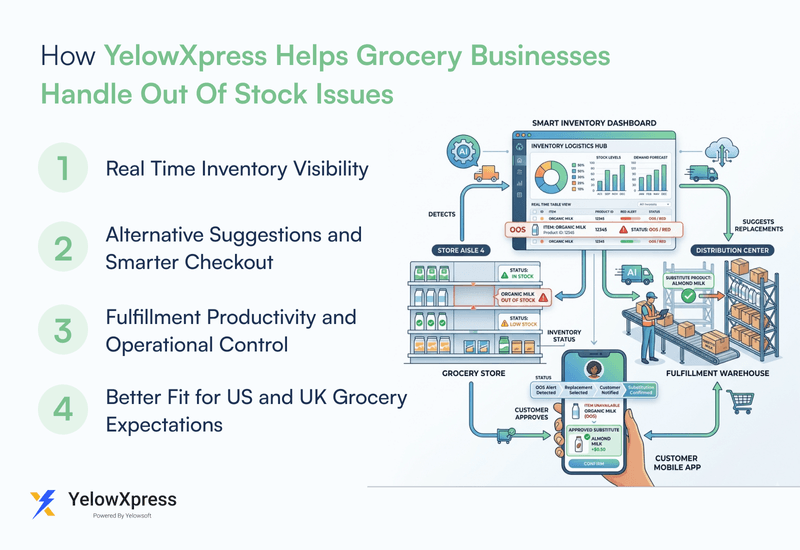
YelowXpress fits this problem because grocery delivery needs more than a simple ordering app. It needs connected operations.
For growing grocery brands, local retailers, supermarkets, and dark store models, YelowXpress can help bring ordering, inventory visibility, fulfillment, delivery, and customer communication into one controlled workflow.
Real Time Inventory Visibility
YelowXpress supports the operational need for real time inventory sync so customers see more accurate product availability before placing an order.
This helps reduce overselling, failed fulfillment, and refund pressure.
For grocery stores handling both offline and online demand, this visibility becomes critical.
Alternative Suggestions and Smarter Checkout
When products are unavailable, the platform can support alternative product suggestions so customers do not leave the cart immediately.
This helps protect conversion and keeps the order moving.
For online grocery, saving the cart is often as important as acquiring the visitor.
Fulfillment Productivity and Operational Control
Vendor reported platform results show business improvements such as 18 percent increase in average order value, 33 percent lift in online conversion rates, and 42 percent improvement in order fulfillment productivity after implementation.
These are platform reported figures, but they reflect the kind of business impact grocery operators look for when moving from manual processes to connected software.
Better Fit for US and UK Grocery Expectations
US and UK grocery buyers expect accuracy, speed, and clear communication.
They want to know what is available, what can be replaced, and when the order will arrive.
YelowXpress supports this expectation by helping grocery businesses build a more reliable online ordering and delivery operation.
That makes it useful for stores trying to reduce aggregator dependency, improve direct ordering, and manage growth without losing fulfillment control.
How to Measure Success After Implementing Grocery Delivery Software
Installing software is not the final goal.
The real goal is measurable improvement.
Track Out of Stock Rate by SKU
Measure how often each SKU becomes unavailable after customers show buying intent.
This helps separate minor catalog gaps from serious revenue problems.
Track Lost Sales from Unavailable Products
Lost sales tracking helps show the financial impact of stockouts.
This gives owners and managers a clearer reason to fix inventory accuracy, replenishment, and supplier performance.
Track Substitution Acceptance
If customers accept replacements, your system is recovering revenue.
If they reject replacements, your substitution logic needs improvement.
Track Fulfillment Productivity
Fulfillment productivity shows whether your team is picking, packing, and completing orders more efficiently.
This is where technology moves beyond inventory and starts improving daily operations.
Conclusion
Out of stock issues are not just product availability problems. They affect customer trust, basket value, repeat orders, support workload, and delivery efficiency.
For grocery businesses in the US and UK, the problem becomes more serious as online demand grows. Customers expect the products they see online to be available. When that expectation breaks, they quickly move to another store or platform.
That is why grocery delivery software is now a core operational system, not just a digital ordering tool. It helps your business sync inventory, forecast demand, manage substitutions, measure lost sales, improve supplier coordination, and recover orders before they turn into complaints.
YelowXpress gives grocery businesses the structure they need to manage online ordering and delivery with better control. If your store is losing orders because of stock gaps, delayed updates, or manual fulfillment, it may be time to move toward a smarter grocery delivery system.
Reduce Stockouts. Save More Orders.