Most restaurant owners believe customer retention depends on food quality, pricing, and customer service. While all three matter, delivery-first restaurants face a different reality.
Customers often judge your business before they even taste the food.
A late delivery creates more than a delayed meal. It triggers refund requests, support calls, poor reviews, frustrated customers, and most importantly, lost repeat orders. Many customers do not complain. They simply stop ordering and move to another restaurant that feels more reliable.
This is where many businesses lose revenue without noticing it.
Customer retention is often lost in the last mile, not in the kitchen. Delivery delays break trust faster than poor taste because customers connect speed with reliability.
In 2026, where customers expect fast updates, live tracking, and accurate ETAs, delivery speed is no longer a bonus. It is the standard.
In this blog, you will understand why late deliveries directly hurt customer retention, what causes these delays, and how the right restaurant delivery management software helps protect repeat orders and long-term revenue.
Why Delivery Speed Has Become a Customer Retention Problem
Before fixing delivery delays, you need to understand why speed directly affects repeat revenue.
Customers Compare Delivery Experience, Not Just Food
Today, your restaurant is not only competing with nearby restaurants.
You are competing with customer expectations shaped by major delivery platforms.
Customers are used to:
-
Live order tracking
-
Accurate ETAs
-
Faster rider assignment
-
Proactive delivery updates
-
Predictable service
This means fast delivery is no longer impressive.
It is normal.bIf your delivery experience feels slower, unclear, or unreliable, customers notice immediately.
Even if your food is excellent, poor delivery weakens trust. That trust is hard to rebuild.
This is why restaurant online ordering systems must focus on delivery execution, not just order placement.
One Late Delivery Can Break Repeat Ordering Behavior
Customers may forgive one late delivery. They usually do not forgive repeated delays.
The problem is not only the delay itself. It is the uncertainty.
When customers do not know where their food is, frustration grows faster.
They start asking:
-
Has my order been missed?
-
Is the rider delayed?
-
Should I call support?
-
Should I order elsewhere next time?
That hesitation breaks repeat ordering behavior.
Once habits break, retention becomes expensive. You then spend more on discounts and promotions just to win back trust. That is preventable revenue loss.
Delayed Orders Hurt Reviews Before They Hurt Revenue
Bad reviews often arrive before visible revenue loss.
A customer who receives cold food after a late delivery may leave:
-
A low Google review
-
A poor aggregator rating
-
Negative social proof
This affects both customer acquisition and customer retention
Future customers see those reviews and hesitate. And existing customers lose confidence.This way, your reputation becomes harder to repair.
This is why food delivery management software must protect delivery consistency, not only dispatch speed.
Expert Tip:
Track repeat complaints by delivery zone, not only by customer name. Many delays are location-based problems, not individual driver problems. Fixing the zone improves retention faster than replacing drivers.
The Hidden Business Cost of Late Deliveries
Most restaurants notice refunds first. The bigger losses usually stay invisible.
Lost Repeat Orders Are More Expensive Than Refunds
A refund feels painful because you see it immediately. But the real danger is the customer who never returns.
That customer represents:
-
Future weekly orders
-
Referral opportunities
-
Loyalty program participation
-
Long-term lifetime value
One lost repeat customer often costs far more than one refunded order. This is why retention matters more than short-term recovery.
If your restaurant keeps replacing lost customers instead of keeping existing ones, growth becomes expensive. Strong restaurant delivery software protects repeat revenue, not just daily orders.
Manual Dispatch Creates Silent Revenue Leakage
Manual dispatch looks manageable in the beginning. But as order volume grows, small delays become serious problems.
Examples include:
-
Missed rider assignment
-
Delayed kitchen handoff
-
Poor route planning
-
No live tracking
-
Repeated support calls
-
Rider confusion during peak hours
These problems create silent leakage.
Revenue drops without obvious warning. You may think sales are stable while repeat customers quietly disappear. This is one reason growing restaurants move toward automated delivery orchestration.
Delivery Delays Increase Discount Dependency
When customers lose trust, restaurants often respond with discounts.
Examples:
-
Apology coupons
-
Refund credits
-
Free delivery offers
-
Retention discounts
These may reduce short-term complaints. But they also reduce margins.
Now the restaurant suffers twice lower customer trust and lower profitability
The thing is: Discounts should support growth, not repair broken operations. The real solution is preventing the delay in the first place.
Common Reasons Restaurants Struggle with Delivery Delays
Most delays are system problems, not effort problems. The common reasons include:
No Centralized Restaurant Delivery Management System
Orders often come from multiple channels:
-
Phone calls
-
Website orders
-
Mobile apps
-
Aggregator platforms
-
WhatsApp messages
When these operate separately, teams lose control. Plus, orders get delayed because staff manually switch between systems.
This creates confusion and slower response times.
A centralized restaurant delivery management system helps every order move through one operational flow. That reduces missed steps.
Poor Driver Allocation and Dispatch Logic
Many restaurants still assign riders manually. This creates avoidable delays.
The nearest available driver is not always assigned quickly. Plus, dispatch teams get overloaded during peak hours.
Drivers wait. Customers wait. Kitchen timing gets affected.
Automated dispatch improves this by assigning the right driver faster and more consistently. That consistency protects customer trust.
Weak Delivery Visibility for Customers and Teams
Sometimes the actual delay is small. But because there is no visibility, customers feel the delay more strongly.
-
No real-time updates create anxiety.
-
Customers assume the worst.
-
Even internal teams struggle without visibility.
They cannot answer customer questions confidently. This increases support pressure.
Live delivery tracking reduces both frustration and unnecessary calls.
Kitchen and Delivery Teams Work in Silos
Food is ready before riders arrive. Or riders arrive before food is prepared.
Both situations damage service quality.
-
Food quality drops.
-
Driver efficiency drops.
-
Customer satisfaction drops.
This happens because kitchen operations and delivery dispatch are disconnected. And a connected workflow solves this.
Expert Tip:
Measure “food ready to driver pickup time” as a separate KPI. Many restaurants only track final delivery time and miss the real operational bottleneck.
How Smart Restaurant Delivery Systems Improve Customer Retention
Retention improves when delivery becomes predictable, visible, and connected. Here’s how smart restaurant delivery systems improve customer retention:
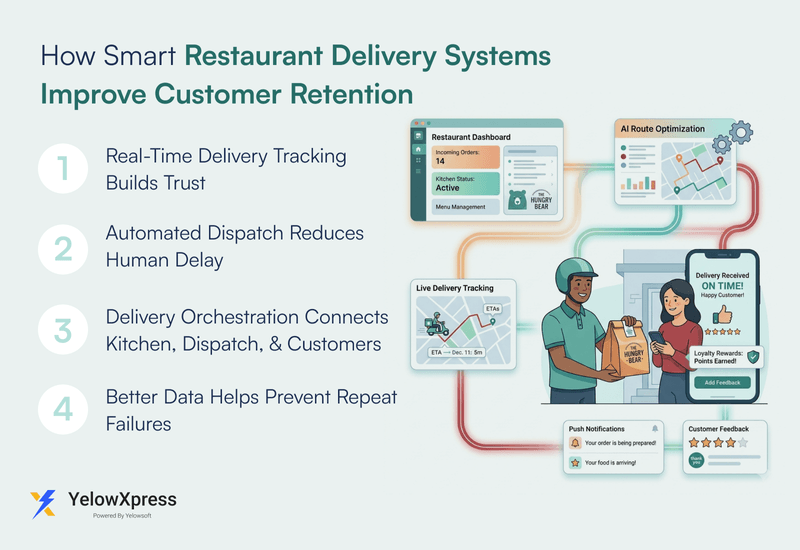
Real-Time Delivery Tracking Builds Trust
Customers are more patient when they know what is happening.
Live tracking helps them see:
-
Rider assignment
-
Estimated arrival
-
Delivery progress
-
Delay updates
Visibility reduces frustration.
It also reduces support tickets because customers no longer need to ask for updates. Trust grows when communication stays clear. This is why real-time delivery tracking software is no longer optional.
Automated Dispatch Reduces Human Delay
Manual dispatch depends on people reacting quickly. Automated dispatch depends on system logic. That difference matters during peak hours.
System-based rider assignment improves:
-
Delivery speed
-
Rider utilization
-
Operational consistency
-
Order accuracy
It removes avoidable waiting time. This protects repeat ordering behavior because customers receive a more reliable experience.
Delivery Orchestration Connects Kitchen, Dispatch, and Customers
The real fix is not just faster riders. It is better coordination.
Delivery orchestration connects:
-
Kitchen preparation
-
Dispatch timing
-
Driver movement
-
Customer communication
This creates smoother execution.
And restaurants stop reacting to delays and start preventing them. That is where retention improves.
Better Data Helps Prevent Repeat Failures
Without data, delays repeat. With analytics, restaurants can identify:
-
Late delivery zones
-
Peak-hour bottlenecks
-
Slow rider patterns
-
Repeat complaint reasons
-
Operational gaps by location
This allows continuous improvement.
Strong restaurant analytics and reporting turn delivery from guesswork into strategy.
What Restaurant Owners Should Look for in a Delivery Retention System
Not every delivery platform protects retention. The right system must support the full customer journey.
Live Order and Driver Tracking
This is non-negotiable.
You need real-time visibility for:
-
active deliveries
-
driver locations
-
customer ETA updates
Without this, delays create unnecessary frustration.
Multi-Channel Order Management
All order sources should work from one dashboard.
This includes:
-
website
-
mobile app
-
phone orders
-
aggregator orders
-
WhatsApp bookings
Centralization prevents operational gaps.
It also improves team productivity.
POS and Kitchen Integration
Orders should move from kitchen to customer without manual gaps.
Disconnected systems create avoidable delays.
Integrated POS and kitchen workflows improve:
-
prep timing
-
order accuracy
-
delivery coordination
This directly supports customer retention.
Customer Communication and Delay Notifications
Silence destroys trust faster than delay itself.
Customers should receive:
-
confirmation messages
-
ETA updates
-
proactive delay alerts
-
delivery completion updates
Clear communication protects loyalty even during service disruption.
Expert Tip:
Do not only track on-time delivery percentage. Also track repeat customer drop-off after delayed orders. That shows the real retention impact.
Conclusion
Customers rarely leave because of one delayed order. They leave because repeated delivery issues break trust and make your service feel unreliable.
When orders arrive late, updates are missing, and support becomes frustrating, customers stop seeing your restaurant as their first choice. That directly affects repeat orders, reviews, and long-term revenue.
The restaurants that grow faster are the ones that treat delivery as a customer retention system, not just a dispatch task. They focus on visibility, automated dispatch, kitchen coordination, and proactive communication before small delays turn into lost customers.
Late deliveries are not only an operational issue. They are a retention problem.
With the right restaurant delivery management software, you can protect customer loyalty, improve delivery consistency, and build stronger repeat revenue. If delivery complaints are increasing, it may be time to fix the system behind them, not just the delivery itself.
Stop Losing Repeat Customers to Delivery Delays
FAQs
Late deliveries reduce repeat ordering significantly because they break customer trust. Many customers do not complain. They simply stop ordering and choose another restaurant next time.
Yes. Live delivery tracking improves customer confidence because people know where their order is and when it will arrive. Visibility reduces frustration and support complaints.
Often yes. Discounts can recover short-term sales, but repeated late deliveries damage long-term trust. Retention loss is usually more expensive than short-term pricing problems.
The best approach is using a connected restaurant delivery management system with automated dispatch, real-time tracking, kitchen integration, and proactive customer communication.