Delivery accuracy becomes harder to maintain as your business grows. More orders, more products, more delivery drivers, and more fulfillment activities create additional complexity across your operations.
What may work efficiently when handling a small number of orders can quickly become difficult to manage as volumes increase.
This is often when delivery order errors begin to appear. Missing items, incorrect products, inventory mismatches, fulfillment delays, and delivery mistakes can affect customer satisfaction, increase operational costs, and reduce repeat purchases.
Many businesses initially assume these errors are caused by employee mistakes. In reality, they are often the result of disconnected systems, manual workflows, limited visibility, and processes that were never designed for scale.
The good news is that delivery errors can be significantly reduced with the right operational approach and technology.
In this blog, you will learn the most common causes of delivery order errors, the hidden costs they create, the features that help prevent them, and why YelowXpress provides a more effective solution for growing delivery businesses.
Let’s get into it now!
What Are Delivery Order Errors and Why Do They Increase as You Scale?
Before exploring solutions, it is important to understand the different types of delivery errors that affect growing businesses. They are:
Common Types of Delivery Order Errors
Delivery order errors can occur at various stages of the fulfilment process.
Common examples include:
-
Missing products
-
Wrong products delivered
-
Incorrect quantities
-
Incorrect customer addresses
-
Duplicate orders
-
Delayed fulfilment leading to cancellations
-
Inventory discrepancies
While each error may seem small individually, its cumulative impact can become significant as your order volumes increase.
Why Small Errors Become Bigger Problems
If you have 20 orders per day, it's still possible to manually review orders.
But as the volume of your orders increases from hundreds to thousands, manual checks become more cumbersome.
You may be dealing with:
-
Multiple ordering channels
-
Multiple fulfilment teams
-
Multiple delivery drivers
-
Multiple store locations
-
Larger product catalogues
And every additional operational layer creates more opportunities for mistakes.
The Relationship Between Order Volume and Error Rates
Many businesses assume delivery errors grow in direct proportion to order volume. In reality, complexity often grows faster than volume.
For example, doubling your order volume may require additional drivers, expanded inventory, new locations, and more customer service interactions. But without proper systems, error rates can increase much faster than business growth.
The Hidden Cost of Delivery Errors Most Businesses Underestimate
Understanding the real impact of delivery errors helps explain why reducing them should be a priority. The hidden cost of delivery errors include:
Direct Financial Costs
Every incorrect delivery creates immediate expenses. These costs often include:
-
Refunds
-
Replacements
-
Additional deliveries
-
Customer support handling
While these expenses are measurable, they are only part of the problem.
Customer Experience Costs
Your customers are mindful of bad experiences. When people see you don't provide what they ordered or when the order comes out of sequence, they don't trust you and are less likely to place another order with you.
Even when issues are resolved quickly, your customer confidence may already be affected.
Operational Costs
Delivery errors also increase internal workload.
And your teams spend valuable time investigating complaints, correcting mistakes, coordinating replacements, and managing customer communication. This reduces overall operational efficiency.
| Error Type | Immediate Cost | Long Term Impact |
|---|---|---|
| Missing Items | Refunds | Customer churn |
| Wrong Orders | Replacements | Reduced trust |
| Delivery Delays | Support costs | Lower retention |
| Inventory Errors | Operational waste | Reduced profitability |
Why Delivery Order Errors Usually Start with Operational Gaps
Most delivery errors are symptoms of larger operational challenges. To solve them effectively, you need to identify where those gaps exist. Here's why:
Manual Order Processing
Manual workflows introduce risk. For example: spreadsheet tracking, phone-based order management, manual order entry, and manual drive assignment.
Thus every manual touchpoint creates opportunities for human error.
Multiple Ordering Channels Without Centralisation
Many businesses like yours receive orders through:
-
Mobile applications
-
Social channels
-
Marketplace platforms
-
In-store systems
When these channels operate separately, you must constantly switch between systems. This increases the likelihood of information being missed and of duplicate processing.
Poor Communication Between Teams
When information is decentralised, greater errors will occur, as will be the case for delivery operations, where store employees, fulfilment teams, dispatch teams, and delivery drivers all participate.
Limited Real Time Visibility
Without real-time operational visibility, your teams struggle to identify issues before they affect customers.
This often leads to delayed responses, inventory confusion, driver allocation mistakes, and fulfilment bottlenecks.
Why Traditional Delivery Software Struggles as Businesses Grow
Many businesses invest in software expecting immediate improvements, yet delivery errors continue increasing.
The reason is simple. Not all delivery platforms are designed for scale. Let's see why:
Fragmented Systems Create Complexity
Traditional systems often require separate tools for:
-
Order management
-
Delivery management
-
Reporting
-
Inventory tracking
This creates operational silos for your business. And instead of simplifying workflows, teams spend time managing multiple systems.
Manual Intervention Remains High
Many solutions still rely heavily on dispatchers and operators.
Tasks often require significant manual involvement such as:
-
Order verification
-
Driver assignment
-
Delivery coordination
As order volumes increase, these processes become harder to manage consistently.
Lack of End to End Workflow Management
Traditional platforms frequently focus on only one part of the delivery process.
For example:
-
Order capture only
-
Driver management only
-
Tracking only
Without complete workflow visibility, businesses like yours can struggle to maintain delivery accuracy.
Poor Scalability During Peak Demand
Promotions, seasonal demand, and peak ordering periods place additional pressure on operations.
Systems lacking automation often experience issues during these high-volume periods like:
-
Delayed fulfillment
-
Assignment bottlenecks
-
Increased delivery errors
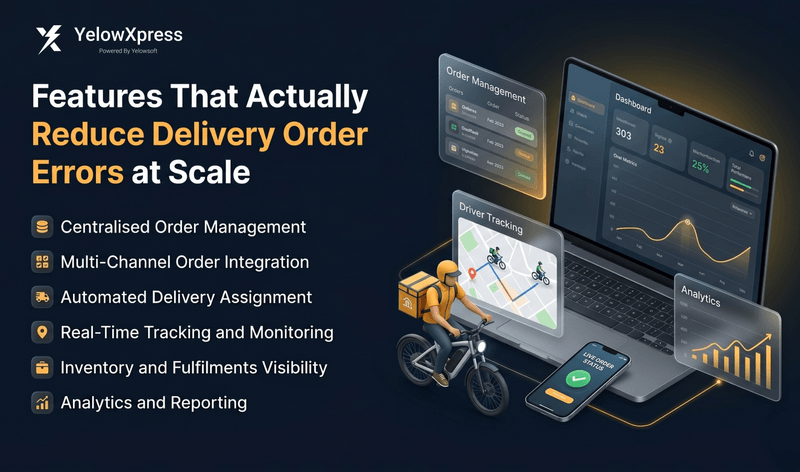
Features That Actually Reduce Delivery Order Errors at Scale
Not every feature contributes directly to operational accuracy. The following capabilities have the greatest impact.
Centralised Order Management
A centralised system creates a single source of truth.
Benefits include:
-
Better order visibility
-
Reduced duplication
-
Improved coordination
Multi Channel Order Integration
Consolidating orders from all channels helps eliminate manual data handling.
Benefits include:
-
Consistent order processing
-
Faster fulfillment
-
Lower error rates
Automated Delivery Assignment
Automation reduces dependency on manual dispatching.
Benefits include:
-
Faster allocation
-
Better resource utilisation
-
Reduced assignment mistakes
Real Time Tracking and Monitoring
Visibility allows teams to identify and resolve issues quickly.
Benefits include:
-
Faster problem detection
-
Better customer communication
-
Improved delivery control
Inventory and Fulfilments Visibility
Accurate inventory information reduces fulfilment errors.
Benefits include:
-
Better stock management
-
Fewer substitutions
-
Improved order accuracy
Analytics and Reporting
Reporting helps identify recurring operational issues.
Benefits include:
-
Trend analysis
-
Continuous improvement
-
Better decision making
Expert Tip:
Do not measure delivery success solely by completed deliveries. Monitor error rates, fulfilment accuracy, and customer complaints to gain a clearer picture of operational performance.
How YelowXpress Reduces Delivery Order Errors Across the Entire Order Journey
Reducing delivery errors requires visibility and control throughout the complete delivery lifecycle. This is where YelowXpress delivers significant advantages.
Order Capture Accuracy
YelowXpress centralises orders from multiple channels into a single platform. This reduces manual entry, duplicate processing, and missing order information. By creating a unified order intake process, you can improve consistency from the start.
Smarter Order Management
Our platform provides centralised order visibility through a unified dashboard. You can monitor order status, track progress, and identify bottlenecks without switching between multiple systems.
Better Fulfillment Coordination
Fulfillment accuracy depends on operational synchronisation. YelowXpress helps coordinate:
-
Store operations
-
Kitchen workflows
-
Vendor activities
This improves communication and reduces preparation mistakes.
Delivery Orchestration for Higher Accuracy
One of the YelowXpress platform's strongest capabilities is delivery orchestration. Rather than treating deliveries as isolated tasks, YelowXpress manages the entire delivery workflow.
This results into:
-
Improved assignment accuracy
-
Better delivery coordination
-
Reduced operational friction
Real Time Tracking and Visibility
Real time tracking enables proactive management. And you gain visibility into:
-
Driver locations
-
Delivery progress
-
Operational performance
This allows faster intervention when issues arise.
Analytics That Help Prevent Future Errors
Operational improvement requires continuous learning. YelowXpress provides reporting and analytics that help businesses identify:
-
Error patterns
-
Process bottlenecks
-
Performance trends
This supports long term operational improvement.
YelowXpress vs Traditional Delivery Solutions
As businesses scale, the difference between delivery management and delivery orchestration becomes increasingly important.
Let's have a look at the difference:
| Capability | Traditional Solutions | YelowXpress |
|---|---|---|
| Centralized Order Management | Limited | Yes |
| Multi Channel Integration | Partial | Yes |
| Delivery Orchestration | Limited | Yes |
| Real Time Visibility | Basic | Advanced |
| Multi Store Management | Limited | Yes |
| Analytics and Reporting | Basic | Advanced |
| Scalability Support | Moderate | High |
The advantage is not a single feature. The real advantage comes from combining multiple operational capabilities into one platform.
Expert Tip:
If your team spends more time correcting delivery mistakes than improving operations, your current system is likely creating operational friction instead of removing it.
Signs Your Business Has Outgrown Its Current Delivery Management System
Many businesses continue using outdated processes longer than they should. Watch for these warning signs.
Customer Complaints Are Increasing: Frequent complaints often indicate operational issues rather than isolated mistakes.
Delivery Errors Are Becoming More Common: Recurring errors in deliveries suggest process limitations.
Dispatch Teams Are Overwhelmed: Excessive manual intervention often signals scalability problems.
Multiple Locations Are Difficult to Manage: Growth should improve efficiency, not create confusion.
Operational Visibility Is Limited: If your teams struggle to understand what is happening in real time, decision making becomes slower and less effective.
Growth Creates More Problems Than Profit: This is one of the clearest indicators that your current system is reaching its limits.
Conclusion
Reducing delivery order errors is not simply about fixing occasional mistakes. It is about building an operation that can maintain accuracy, consistency, and customer trust as order volumes grow.
As your business expands, the number of moving parts also increases. More products, more delivery drivers, more fulfilment tasks, and more ordering channels create additional opportunities for errors if your processes remain manual or disconnected.
Missing items, incorrect deliveries, and fulfilment delays can quickly impact customer satisfaction, increase operational costs, and limit long-term growth.
The most effective way to reduce delivery errors at scale is to create visibility and control across the entire order journey.
Centralised order management, delivery orchestration, real-time tracking, inventory visibility, and performance analytics help you identify issues before they affect your customers.
If your goal is to improve delivery accuracy while supporting sustainable growth, YelowXpress gives you the tools to streamline operations, reduce operational friction, and deliver a more reliable experience at every stage of the delivery process.
Ready to Reduce Delivery Order Errors at Scale?
FAQs
Delivery order errors usually occur due to manual order processing, disconnected systems, inventory inaccuracies, communication gaps, and limited visibility across fulfilment and delivery workflows. As order volumes increase, these operational challenges become harder to manage without centralized automation.
Businesses can reduce delivery order errors by centralizing order management, automating fulfilment workflows, integrating all ordering channels, improving inventory visibility, and using real time delivery tracking.
Delivery errors increase as order volumes grow because businesses manage more products, drivers, locations, and customer requests simultaneously. Without scalable systems and standardized processes, operational complexity rises and creates more opportunities for fulfilment and delivery mistakes.
Effective delivery management software should include centralized order management, delivery orchestration, automated dispatching, real time tracking, inventory synchronization, multi channel integration, and analytics.
YelowXpress helps reduce delivery order errors through centralized order management, delivery orchestration, real time operational visibility, automated workflows, and advanced reporting.